Welding Processes Handbook
This explanatory guide to the commercially significant and commonly-used welding processes covers the design of welded joints, quality assurance and costing, and can be applied to all instruction levels.
 TABLE OF CONTENTS
 Methods for joining metals have been known for thousands of years, but for most of this period the only form of welding was forge welding by a blacksmith.
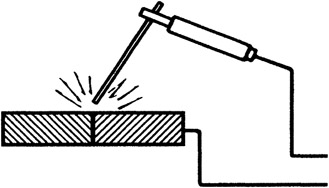
A number of totally new welding principles emerged at the end of 19th century; sufficient electrical current could then be generated for resistance welding and arc welding. Arc welding was initially carried out using carbon electrodes, developed by Bernados, and was shortly followed by the use of steel rods. The Swede Oskar Kjellberg made an important advance when he developed and patented the coated electrode. The welding result was amazing and formed the foundation of the ESAB welding company.
Another early method of welding which was also developed at that time was gas welding. The use of acetylene and oxygen made it possible to produce a comparatively high flame temperature, 3100 C, which is higher than that of other hydrocarbon based gas.
The intensity of all these heat sources enables heat to be generated in, or applied to, the workpiece quicker than it is conducted away into the surrounding metal. Consequently it is possible to generate a molten pool, which solidifies to form the unifying bond between the parts being joined.
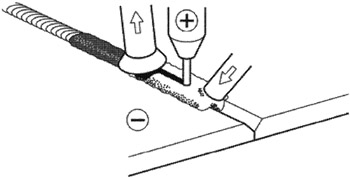
Later, in the 1930s, new methods were developed. Up until then, all metal-arc welding had been carried out manually. Attempts were made to automate the process using a continuous wire. The...