Welding Processes Handbook
This explanatory guide to the commercially significant and commonly-used welding processes covers the design of welded joints, quality assurance and costing, and can be applied to all instruction levels.
 TABLE OF CONTENTS
 The plasma welding method employs an inner plasma gas and outer shielding gas, as shown in Figure 4.1. The plasma gas flows around a retracted centred electrode, which is usually made of tungsten. The shielding gas flows through the outer jet, serving the same purpose as in TIG welding.

A plasma arc is considerably straighter and more concentrated than, for example, a TIG arc, which means that the method is less sensitive to arc length variations: see Figure 4.2.
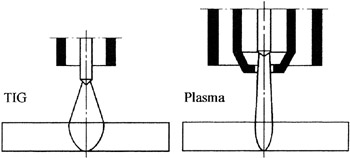
The plasma welding process can accept variations of 2 3 mm in the arc length without significantly altering the heat input to the workpiece. This this is approximately ten times better than the corresponding value for TIG welding. However, because the arc is narrower, more accurate transverse control is important, which means that the method is normally used in mechanised welding.
Characteristic features of the method include:
the concentrated stable arc
high welding speed
insignificant deformation of the workpiece
reliable arc ignition.
With the exception of magnesium, the method is suitable for welding the same materials as those that can be welded by TIG welding. Automated welding of stainless steel pipes is...