Welding Processes Handbook
This explanatory guide to the commercially significant and commonly-used welding processes covers the design of welded joints, quality assurance and costing, and can be applied to all instruction levels.
 TABLE OF CONTENTS
 The main purpose of the power source is to supply the system with suitable electric power. Furthermore, the power source performance is of vital importance for the welding process; the ignition of the arc, the stability of the transfer of the melted electrode material and for the amount of spatter that will be generated. For this purpose it is important that the static and dynamic characteristics of the power source is optimised for the particular welding process.
The static characteristics of a power unit can be plotted by loading the power unit with an adjustable resistive load. We speak of drooping characteristics, constant-current characteristics and straight characteristics (constant-voltage characteristics).
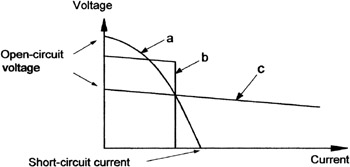
A constant-current characteristic is used when the arc length is controlled by the welder, e.g. in TIG welding. If the arc length is unintentionally changed, the arc voltage changes to maintain a constant current.
A drooping characteristic is used for MMA welding, where it is an advantage if the short-circuit current is somewhat higher than the normal load current in order to prevent the electrode from 'freezing' to the workpiece when attempting to strike the arc. A drooping characteristic, as compared with a straight characteristic, also permits a higher no-load voltage, which is needed when welding with AC in order to prevent the...