Welding Processes Handbook
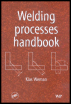
This explanatory guide to the commercially significant and commonly-used welding processes covers the design of welded joints, quality assurance and costing, and can be applied to all instruction levels.
 TABLE OF CONTENTS
 Soldering and brazing are important industrial methods of bonding metals, and are especially widely used in connection with mass production. They have their given applications in connection with particular materials and components, for which welding is unsuitable due to the considerably higher temperatures and limited abilities to bond different metals. Soldering and brazing are simple and suitable bonding processes for joining ferrous metals to non-ferrous metals, and for bonding metals having very different melting temperatures. They are the main methods of bonding used in the manufacture of products made of copper or copper alloys. Although the main applications differ from those of welding, they can in many cases be fully acceptable alternatives to welding.
The processes are economic due to the lower working temperatures and to the fact that there is generally no need for any substantial chipping, grinding or cleaning of the joint as a finishing process.
The following section gives an introduction to soldering and brazing methods by describing the fundamental principles, with brief descriptions of the various methods.
Soldering or brazing involves heating the area to be joined to the working temperature of the filler metal, or to a somewhat higher temperature. As the working temperature is always lower than the melting temperature of the base material, and generally very much lower, the base material will remain solid throughout the process. This is the main difference in principle between soldering/brazing and welding. A flux is generally used in order chemically to remove oxides from...