Welding Processes Handbook
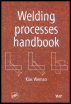
This explanatory guide to the commercially significant and commonly-used welding processes covers the design of welded joints, quality assurance and costing, and can be applied to all instruction levels.
 TABLE OF CONTENTS
 Until the 1970s, manual metal arc was the most dominant method of welding. Today MIG/MAG is the obvious leading contender in most industrial countries. Gas metal arc welding (GMAW) can also be referred to as MIG (metal inert gas) if the shielding gas is inert as for example argon or MAG (metal active gas) if the gas has a content of an active gas such as CO 2.
Figure 5.1 shows the principle of MIG/MAG welding. The arc (1) is struck between the workpiece and a metal wire electrode (2) that is continually fed forward into the arc. The wire is supplied on a reel (3), and is fed to the welding gun by the drive rollers (4), which push the wire through a flexible conduit (5) in the hose package (6) to the gun (7). Electrical energy for the arc is passed to the electrode through the contact tube (9) in the welding gun. This contact tube is normally connected to the positive pole of the power source, and the workpiece to the negative pole. Striking the arc completes the circuit. The gas nozzle (11) that surrounds the contact tube (9) supplies shielding gas (10) for protection of the arc and the weld pool (12).


The wire reel is placed on a brake hub with adjustable friction. The intention is to stop rotation when the feeding has stopped in...