Wideband Amplifier Design

So far, we have not been overly concerned about low-frequency effects. Unfortunately, there are several issues that operate at DC or low frequencies that cause problems at higher frequencies. The changing of g m with some circuit parameter ( g m modulation) and the thermal effects as a function of signal level and power are two such examples. Fortunately, a variety of circuits and techniques have been developed to either correct or greatly alleviate these problems. This chapter is devoted to these concepts.
We begin this chapter using the basic hybrid- ? model to derive low-frequency gain equations. While some of this repeats information from the previous chapters, a more coherent flow should make the concepts a little easier to follow.
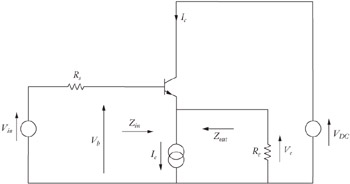
We begin with the circuit shown in Figure 4-1. We want to find the low-frequency input and output impedance along with various voltage and admittance gains for this circuit.
To do this, we will make use of the hybrid- ? model for the transistor. Please note that the following parameters are used in this model:
| (4.1) | |
| (4.2) | |
Here I c is the DC collector current and V t is the thermal voltage,
and is 26 mV at room temperature. ? is the small signal ? (or
) for the device.
Figure 4-2...