Working Guide to Process Equipment, Third Edition

Distillation towers are the heart of a process plant, and the working component of a distillation column is the tray. A tray consists of the following components, as shown in Fig. 3.1:
Overflow, or outlet weir
Downcomer
Tray deck
There are two types of tray decks: perforated trays and bubble-cap trays. In this chapter, we describe only perforated trays, examples of which are
Valves or flutter caps
V grid, or extruded-valve caps
Sieve decks
Jet trays
Possibly 90 percent of the trays seen in the plant are of these types. Perforated tray decks all have one feature in common; they depend on the flow of vapor through the tray deck perforations, to prevent liquid from leaking through the tray deck. As we will see later, if liquid bypasses the outlet weir, and leaks through the tray deck onto the tray below, tray separation efficiency will suffer.
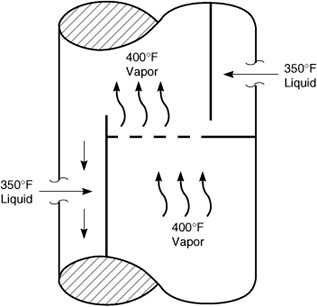
Distillation trays in a fractionator operate between 10 and 90 percent efficiency. It is the process person s job to make them operate as close to 90 percent efficiency as possible. Calculating tray efficiency is sometimes simple. Compare the vapor temperature leaving a tray to the liquid temperature leaving the trays. For example, the efficiency of the tray shown in Fig. 3.2 is 100 percent. The efficiency of the tray in Fig. 3.3 is 0 percent.
How about the 10 trays shown in Fig. 3.4?