Working Guide to Process Equipment, Third Edition

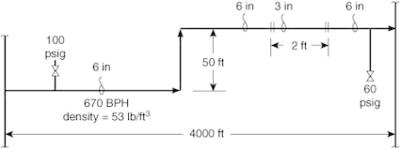
An engineer has been assigned to check a kerosene process line for ? P. The chief operator suspects the line is partly plugged (see Fig. 40.1):
Kinematic viscosity of kerosene is 0.6 cSt. Therefore, viscosity is not a critical factor because it is less than 5 to 10 cSt.
Note that centistokes = centipoise divided by density. The density in this case is approximately 0.9g/cm 3.
Observed (measured) ? P is 40 psi.
Figure 40.1: Pressure drop survey in a kerosene pipeline.
Loss of pressure due to head gain of 50 ft is:
| () | |
Note that the 2.31 factor is the height in feet of a column of water that will exert a pressure equal to 1 psi, and atmospheric pressure 14.7 psi is equivalent to a height of approximately 30 ft of water.
The actual flowing pressure loss corrected for elevation is then:
| () | |
The 6-in diameter line has a short 2-ft long restriction where the pipe size is reduced to 3-in diameter (see Fig. 40.1). Line lengths this short (i.e., 2 ft) can be treated as a nozzle as follows:
| () | |
The 0.34 is a nozzle-loss coefficient. The 20 ft/s is the velocity of the kerosene in the 3-in restriction. The 28 factor converts ? P from inches of water pressure drop to psi.
The ? P over the 3-in restriction is 4 psi.
The remaining ? P due to friction loss in the 6-in...