Working Guide to Process Equipment, Third Edition

Take a look at Fig. 40.7. This should give you an idea of some of the variations of fluid flow behavior. The gradients or slopes of these lines or curves are variable within the identified flow regime. It is whether or not the curves pass through the origin and the general shape of the curve that defines the type of behavior.
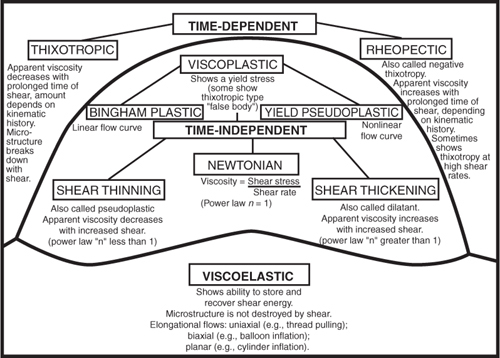
The diagram shown in Fig. 40.8 is also included to guide you as we take a little closer, qualitative look at some of these types of non-Newtonian flow (for more detailed information we suggest you begin with the references 4, 5, and 6 at the end of this chapter).
As the name suggests, this type of flow behavior is not affected by the length of time that the fluid has been flowing or being moved. We say it is unaffected by the duration of the shear which it experiences. This type of flow is the best documented, and some simple models of predicting flow exist to which we will later refer.
In this group we have Newtonian flow with which we are familiar, shear-thinning, shear-thickening, and viscoplastic flow. Please note once again that these non-Newtonian types of flow may be exhibited by fluids that will indeed also behave as Newtonian liquids over a particular range of shear rates.
Shear-thinning liquids in general...