Working Guide to Process Equipment, Third Edition
40.3: Line Sizing for Low-Viscosity and Turbulent Flow

40.3 Line Sizing for Low-Viscosity and Turbulent Flow

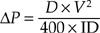
Just as we used this simple formula:

()

earlier in this chapter to evaluate pipeline pressure drop, we can also use this same formula to check line sizes for low-viscosity fluids (less than 3 cP) in turbulent flow. The expected loss in pressure for 100 equivalent ft of horizontal pipe should be between 0.1 and 1.0 psi. If you find that the expected ? P per 100 equivalent ft of horizontal pipe is more than 1.0 psi, then we would propose an increase in pipe diameter that would bring the ? P per 100 equivalent ft within the range of 0.1 to 1.0 psi. The converse is also true. However, if you are designing new pipe work, you should aim for 1 psi per 100 ft.

Note that our choice of standard pipe diameter becomes more restricted for larger diameter pipe, where the increments of standard pipe diameter are greater than for small diameter pipes.

Well, I suppose that was easy enough to follow. Let s just backtrack a little now so that we can put the information we have had so far in its proper context. Certainly that equation for ? P is simple enough to use, but how do we know if it is really valid for the fluid and the flow we are dealing with? How do we know if the fluid is in turbulent flow, and for that matter, what is turbulent flow anyway? Why are...

UNLIMITED FREE
ACCESS
TO THE WORLD'S BEST IDEAS

SUBMIT
Already a GlobalSpec user? Log in.

This is embarrasing...

An error occurred while processing the form. Please try again in a few minutes.

Customize Your GlobalSpec Experience

Category: Turbine Flow Meters
Finish!
Privacy Policy

This is embarrasing...

An error occurred while processing the form. Please try again in a few minutes.