Working Guide to Process Equipment, Third Edition

The concept of the super-fractionation separation stage in distillation is a key concept in process operations and chemical engineering. Yet I have never seen this idea discussed in any text concerning distillation.
The effect is observed in two areas of a distillation operation:
Partial condensation
Once-through thermosyphon and kettle reboilers
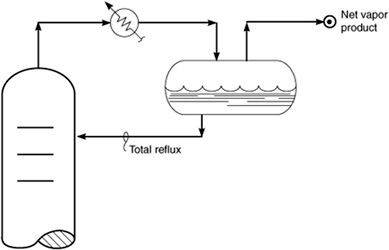
The concept of a super-fractionation tray is important when separating products, if either the top or bottom product consists of a multicomponent mixture. For example, if we are fractionating only a mixture of propane and isobutane, the super-fractionation concept would not be significant. However, if the product consisted of a mixture of ethane, propane, and isobutane (i.e., C 2s, C 3s, and C 4s) and the overhead condenser was a partial condenser (see Fig. 41.1), then the partial condenser would serve as a super-fractionation stage. The partial condenser would contribute far more to fractionation than any of the other stages in the upper portion of the distillation tower.
If the bottom product consisted of a mixture of isopentane, normal hexane, and normal heptane (i.e., C 5s, C 6s, and C 7s) and the reboiler was a kettle-type reboiler (see Fig. 41.2), then the kettle reboiler would serve as a super-fractionation stage. The kettle reboiler would contribute far more to fractionation then any of the other stages in the lower portion of the distillation tower.