Working Guide to Process Equipment, Third Edition

Chapter 34: Gas Compression: The Basic Idea The Second Law of Thermodynamics Made Easy

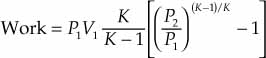
This chapter establishes the basis for the Second Law of Thermodynamics. It is not critical that you read this chapter to be able to understand the more practical chapters on compression that follow. But for those readers who have technical training, wouldn t it be lovely to actually understand the basis for the Second Law of Thermodynamics. Wouldn t it be grand to really see the beauty and simplicity of the basis for the adiabatic compression work equation:

()

I have also written this chapter so that the nontechnical reader can easily comprehend the basis for this Second Law.

34.1 Relationship between Heat and Work

Robert Julius Mayer was a physician practicing near Bavaria in the 1840s. As part of his research into human metabolism, he decided to determine the equivalence between heat and work.

Heat means British thermal units, or the amount of fuel we have to burn to increase the temperature of a pound of water by one degree Fahrenheit. Work means foot-pounds, or the amount of effort needed to raise a one pound brick by one foot.

The experiments that people like Dr. Mayer performed established the technical basis for the industrial revolution. Dr. Mayer himself laid the foundation for the main pillar supporting this technical basis. This was the science of thermodynamics. But in the nineteenth century, they had not coined the word thermodynamics. They called it heat in motion. 1 The branch of science that we now call thermodynamics was developed by simply...

UNLIMITED FREE
ACCESS
TO THE WORLD'S BEST IDEAS

SUBMIT
Already a GlobalSpec user? Log in.

This is embarrasing...

An error occurred while processing the form. Please try again in a few minutes.

Customize Your GlobalSpec Experience

Category: Technical Training Equipment
Finish!
Privacy Policy

This is embarrasing...

An error occurred while processing the form. Please try again in a few minutes.