 Intended as a textbook for electronic circuit analysis or a reference for practicing engineers, the book uses a self-study format with hundreds of worked examples to master difficult mathematic topics and circuit design issues. Computer programs using PSpice and MATLAB on the accompanying CD-ROM provide calculations and executables for visualizing and solving applications from industry. It covers the complex mathematical topics and concepts needed to understand and solve serious circuits problems.
 TABLE OF CONTENTS
 Network Analysis and Circuits
Chapter 12.8 - Series Resonance And Selectivity Of Series RLC Circuit With Frequency Variable
12.8 SERIES RESONANCE AND SELECTIVITY OF SERIES
RLC CIRCUIT WITH FREQUENCY VARIABLE
The impedance of a series RLC circuit is given by
where ω is any frequency.
For ω close to the resonant frequency ω0, Equation (12.23) does not
yield very accurate results.
It is desirable in such a case to use a special relation valid only for frequencies
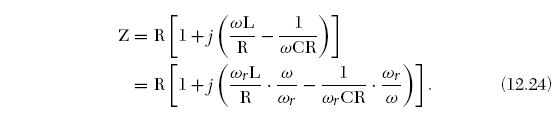
close to the resonant frequency. Thus, Equation (12.26) may be put as,
At resonance,

Hence,

where Qr is the value of Q at resonance.
Hence, Equation (12.24) may be put as,

The fractional frequency variation is given by

Hence,

Hence, Equation (12.26) may be put as,

If ω is close to ω0, then δ < 1.
Hence,

and

Hence, Equation (12.28) reduces to,

Hence, the current

Figure 12.12 shows the variation of current I with the frequency as
obtained from Equation (12.29).
At resonance,

At half-power frequencies f1 and f2, the magnitude of the reactive component
of impedance equals the resistance, i.e.,

At these half-power frequencies f1 and f2, the current

From Equation (12.29), at half-power frequencies,

In Equation (12.31), the positive sign applies for the upper half-power
frequency f2, while the negative sign applies for the lower half-power
frequency f1.

FIGURE 12.12 Variation of current with frequency in a series RLC current.
For upper half-power frequency f2 from Equation (12.31),

Hence,

Similarily,

From Equations (12.32) and (12.33) we see that (f2 − fr) = (fr− f1), i.e.,
the half-power frequencies f2 and f1 are symmetrically disposed with respect
to the resonant frequency fr. Also the response curve, i.e., current versus
frequency curve, is symmetrical about the resonant frequency fr.
But Equations (12.32) and (12.33) are true only when δ << 1. This condition
is satisfied only when the circuit is highly selective, i.e., when Qr is large.
For the low Q circuit, i.e., when R is large, the half-power frequencies f1 and
f2 are away from the resonant frequency fr. The impedance Z is then given by
Equation (12.28) instead of Equation (12.29). Half-power frequencies must
then be calculated from Equation (12.28), i.e., from the following equation,

Thus, for the low selectivity circuit, for example, (f2− f0) ≠ (f0 − f1), the
response curve is not symmetrical about the resonant frequency.
Referring back to Equations (12.32) and (12.33) for the high Q circuit,
by addition of the equations, we get

Let the half-power bandwidth (f2− f1) be indicated by Δf. Then
selectivity

From Equation (12.36), we find for a given value of f , the bandwidth Δf
varies inversely with Qr. The larger the value of Qr , the lesser the bandwidth
and more selective is the circuit.
At a lower half-power frequency ω1,

Similarly, at an upper half-power frequency ω2,

Adding Equations (12.37) and (12.38), we get

or

Hence,

But

Hence,

and we can also write

© 2026 Infinity Science Press