
Cable Carriers Information
 Cable carriers organize conduits such as cables, hoses, and chains through a series of flexible links. They are used to prevent cable damage in equipment with moving parts.
Automation systems are typically energized by some length of power cable or hose, both of which may be cycled at high speeds due to moving machinery. While automation cables are almost always constructed using abrasion-resistant jacketing to alleviate this problem, they may still "corkscrew" and deteriorate due to constant motion and small cable bend radii.
The problems associated with cable abrasion and failure can be solved by using a cable carrier. These products are essentially flexible, armored tunnels through which cables pass; a series of links on the carrier facilitate motion. Cable carriers are typically constructed of metal or some nonmetallic composite material and may include removable sections for ease of periodic cable maintenance.
Types of Cable Carriers
There are two basic types of cable carriers: open and enclosed.
Open cable carriers use crossbars to contain the conduits.
Enclosed cable carriers cover the conduits completely. Tube-style carriers, a specific type of enclosed device, have solid lids for protecting cables against environmental contaminants.
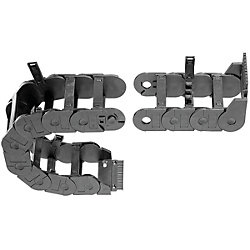

An open (left) and enclosed cable carrier.
Image credit: Grainger | Gortrac
Features
Cable carriers are available with features that enhance their performance in specific applications.
-
Designed to withstand high levels of mechanical stress.
-
Designed to withstand exposure to weather.
-
Hinged or removable crossbars or covers to facilitate the installation and removal of conduits.
-
Feed-through or snap-through features hold the crossbars or covers in place when conduits are installed or removed.
-
Zipper-style cable carriers have crossbars that are connected so that opening one crossbar also opens the adjacent crossbar.
-
Vertical partitions or horizontal dividers separate conduits.
-
Removable links that can be added or removed to change the carrier length.
-
Strain reliefs, located at each end of the cable carrier, can be used to keep cables, hoses, or chains in position.
-
Armor-plated cable carriers are used in harsh environments where contaminants may damage the conduit.
Specifications
The following specifications should be considered when designing a system using a cable carrier.
-
Both the inside width and the inside height measure a cross-section.
-
The mounting height is the minimum height from the bottom of the cable carrier to the top of the curved section.
-
The bend radius is the radius of the curved section, measured to the center of the cable carrier. Most cable carrier manufacturers recommend that the radius be at least 8-10 times the diameter of the thickest cable passing through the carrier. Larger bend radii are desirable, as they place less stress on the cables and result in longer cable life. Bend radius is measured from the center of the curve to the side link pivot pin and is labeled as (R) in the image below.

Image credit: igus
References
Design News - Selecting a cable carrier system
Image credit: KabelSchlepp | igus