
Adjustable Preload Linear Bearings
Description
Adjustable preload linear bearings are specialized components designed to manage the axial force within a bearing assembly. They are engineered to eliminate slop or gaps by maintaining a minimum designed axial force, known as the bearing preload. This ensures smooth and tight rotation by compensating for the stack-up of tolerances within the assembly.
Working Principle
The working principle of adjustable preload linear bearings involves the adjustment of the preload force to eliminate clearance between the bearing and its guide. This is achieved by increasing the contact area between the components, which enhances stiffness and reduces deflection. Preloading is crucial as it helps in maintaining the rigidity of the system, ensuring that the bearings operate quietly and accurately, and extending their service life. The preload can be adjusted using various methods, such as threaded systems where a stop nut or bolt is used to fine-tune the preload level.
Applications
Adjustable preload linear bearings are used in precision rotary applications, particularly in high-speed environments where accuracy and rigidity are paramount. Specific examples include their use in guide-wheel linear motion systems, where they help in maintaining contact and compression against mating tracks, thus enhancing the system's functional value and reducing maintenance costs.
Advantages over other Linear Bearings
One of the key advantages of adjustable preload linear bearings is their ability to be serviced in the field with minimal stocked parts, thanks to the infinitely adjustable preload. This flexibility allows for easy compensation of minor dimensional differences in the assembly, which is not possible with profile rail-based systems that require factory-set preload levels. Additionally, adjustable preload bearings can improve accuracy and optimize bearing life by eliminating the need for shimming and simplifying assembly.
Limitations
A significant limitation of adjustable preload linear bearings is the potential for increased friction due to the higher contact area required to eliminate clearance. This can lead to higher operating temperatures and energy consumption. Additionally, the preload amount is limited and dependent on the specific adjustment mechanism used, such as threaded systems.
Considerations
When considering adjustable preload linear bearings, it is important to evaluate the initial costs and operating expenses, as these can vary based on the complexity of the preload adjustment mechanism. Durability and accuracy are enhanced by proper preload adjustment, but this also requires regular maintenance to ensure optimal performance. Replacement and maintenance costs should be factored into the overall cost of ownership, as improper preload can lead to premature wear and failure of the bearings.
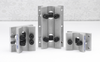
from Lee Controls, LLC
The unique design of the patented Roller Bearing Pillow Block incorporates a larger "rolling" diameter than conventional linear ball bearing pillow blocks. The larger rolling diameter enables the bearing to operate at significantly higher speeds and acceleration. Constructed with an aluminum body... [See More]
- Bearing Features: Adjustable Preload; Lubrication Port (optional feature); Recirculating Bearings; Self Aligning; Wipe / Seal; Top Grease
- Special Bearing Materials: Corrosion Resistant.
- Bearing Type: Linear Roller
- Bearing Width: 2
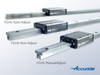
from Accuride International, Inc.
The FG115 Friction Guide includes a lightweight, corrosion-resistant track and carriage to deliver smooth and silent linear movement to industrial applications. Tracks are available in 1m or 2m. Carriages are available in Auto-Adjust, Non-Adjust, and Manual Adjust options. Able to withstand harshest... [See More]
- Bearing Features: Adjustable Preload
- Dynamic Cap.: 899
- Bearing Type: Linear Motion Guide
- Bearing Housing: Rectangular