
Laser / Heat Resistant Spherical Lenses
Description
Laser / Heat Resistant Spherical Lenses are precision optical components designed to withstand high temperatures and intense laser exposure. These lenses are crafted from materials that offer high thermal resistance and minimal absorption of laser energy, ensuring they maintain their shape and functionality under demanding conditions. They are typically used in laser systems to focus or collimate laser beams, providing essential control over the beam's path and intensity.
Working Principle
The working principle of Laser / Heat Resistant Spherical Lenses involves the refraction of laser light through a curved surface, which focuses or diverges the beam depending on the lens design. These lenses are made from materials like UV fused silica, which have low thermal expansion and high resistance to thermal shock, ensuring stability and accuracy even under fluctuating temperatures . The lenses often feature anti-reflective coatings to enhance light transmission and reduce energy loss, making them highly efficient in laser applications .
Applications
Laser / Heat Resistant Spherical Lenses are used in a variety of laser-based applications. They are crucial in laser cutting systems, where they focus the laser beam to a fine point for precise material removal. These lenses are also employed in laser welding, where they help concentrate the laser energy to create strong, clean welds. In laser scanning technology, they ensure high accuracy by minimizing spherical aberration . Additionally, they are used in laser illumination and laser collimation systems .
Advantages over other Spherical Lenses
One of the primary advantages of Laser / Heat Resistant Spherical Lenses over conventional lenses is their ability to withstand high temperatures without distortion or damage. Materials like UV fused silica offer superior thermal resistance and low absorption, preventing thermal effects that can degrade lens performance . These lenses also provide enhanced durability and reliability due to their resistance to thermal shock, making them suitable for high-intensity laser applications .
Limitations
Despite their advantages, Laser / Heat Resistant Spherical Lenses have limitations. They can be more expensive than standard lenses due to the specialized materials and coatings required for high thermal resistance. Additionally, while they are highly durable, they may still require careful handling and maintenance to prevent damage from environmental factors or improper use.
Considerations
When selecting Laser / Heat Resistant Spherical Lenses, several factors should be considered. Initial costs can be higher due to the advanced materials and manufacturing processes involved. However, their durability and resistance to thermal damage can reduce long-term operating expenses by minimizing the need for frequent replacements. Accuracy is a key benefit, as these lenses maintain their optical properties under high thermal loads. Maintenance costs may include periodic cleaning and inspection to ensure optimal performance, but their robust design generally leads to lower maintenance requirements compared to less durable lenses.
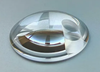
from Suzhou Jiujon Optics Co., Ltd
Our spherical lens features a unique design that includes a strategically placed through hole, allowing laser beams to pass seamlessly through. This innovative configuration not only optimizes the detection process but also significantly improves the accuracy of hot metal detection. The lens is... [See More]
- Lens Form: Plano-Convex
- Lens Features: Laser / Heat Resistant

from Ross Optical Industries
Similar to Standard Achromats but smaller in diameter, these Micro Achromats provide good spherical and chromatic correction, enabling them to be used in laser applications. [See More]
- Lens Form: Convex-Convex
- Focal Length: 6
- Lens Application: Infrared (optional feature); Visible; Ultraviolet (optional feature)
- Diameter: 3
from Ophir-Spiricon Inc.
Plano-convex lenses provide a greater depth of field [See More]
- Lens Form: Plano-Convex
- Focal Length: 318
- Lens Application: Infrared
- Diameter: 25.4
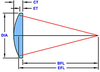
from Ross Optical Industries
Fused Silica material has advantages over regular optical glasses. It is often used in deep UV or NIR systems due to its high transmission in those spectral regions. Due to the material ’s inherently hard SiO2 amorphous structure and its exceptional chemical homogeneity, it displays high laser... [See More]
- Lens Form: Plano-Convex
- Focal Length: 15
- Lens Application: Infrared (optional feature); Visible; Ultraviolet (optional feature)
- Diameter: 7.5

from Ross Optical Industries
Our catalog Laser Achromats are designed primarily for a diode laser with an 830nm wavelength. They perform well through the near-infrared spectrum. They have been corrected for spherical aberration, coma and astigmatism. They are intended to be used for diode beam manipulation. [See More]
- Lens Form: Convex-Convex
- Focal Length: 10
- Lens Application: Infrared; Visible (optional feature); Ultraviolet (optional feature)
- Diameter: 5