
Germanium Spherical Lenses
Description
Germanium spherical lenses are optical components designed to manipulate light by either converging or diverging it, depending on their specific design. These lenses are crafted from germanium, a material known for its high refractive index and low chromatic dispersion, making them particularly effective in the infrared spectrum. They are used to achieve a shorter focal length with fewer lenses, resulting in a more compact optical system.
Working Principle
Germanium spherical lenses operate by utilizing the material's high refractive index to bend light rays as they pass through the lens. This bending of light allows the lens to focus or disperse light, depending on its curvature. The low chromatic dispersion of germanium ensures minimal chromatic aberration, leading to clearer and more precise imaging. These properties make germanium lenses highly useful in infrared applications, where precise light manipulation is crucial.
Applications
Germanium spherical lenses are widely used in infrared thermal imaging cameras, where they serve as the front optic to capture thermal images. They are also employed in CO2 laser processing machines, which operate at lower power densities. Additionally, germanium lenses are integral to the design of FLIR (Forward Looking Infrared) systems and FTIR (Fourier Transform Infrared) spectroscopes, which are used for various investigative and analytical purposes.
Advantages over other Spherical Lenses
Germanium lenses offer several advantages over other spherical lenses, particularly in infrared applications. Their high refractive index allows for a more compact lens design with fewer components, which is not achievable with other materials. The low chromatic dispersion of germanium results in reduced chromatic aberration, enhancing image quality. These lenses are also capable of operating effectively in both the MWIR (Mid-Wave Infrared) and LWIR (Long-Wave Infrared) spectrums, making them versatile for various infrared applications.
Limitations
One significant limitation of germanium spherical lenses is their sensitivity to temperature. The transmission rate of germanium decreases as the temperature rises, becoming completely opaque at around 200°C. This makes them unsuitable for high-temperature environments. Additionally, germanium's high density can lead to weight issues in applications where minimizing weight is critical.
Considerations
When considering germanium spherical lenses, it is important to account for their initial costs, which can be higher due to the specialized nature of the material and manufacturing processes. Operating expenses may also be influenced by the need for specific coatings, such as anti-reflection coatings, to optimize performance. In terms of durability, germanium lenses are chemically inert and can withstand harsh environmental conditions, but their weight and temperature sensitivity must be managed carefully. Maintenance and replacement costs should also be considered, particularly in applications where lenses are exposed to challenging conditions.

from Avantier Inc.
Avantier specializes in the manufacturing of high-quality plano-convex lenses, which are optical lenses with a positive focal length. These lenses are versatile and can be tailored to suit your specific application by offering a wide range of sizes, substrates, and coatings. Plano-convex lenses are... [See More]
- Materials: BK7 Glass; Germanium
- Center Thickness: 0.0500
- Lens Form: Plano-Convex
- Surface Quality: 20-10 Scratch / Dig
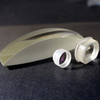
from Changchun Sunday Optics Co., Ltd.
The H-K9L double concave lens has excellent transmittance from visible to near infrared (350-2000nm).H-K9L (N-BK7) is a commonly used optical glass for the preparation of high-quality optical elements. When the additional advantages of UV melting quartz (good transmittance and low thermal expansion... [See More]
- Materials: Germanium; Sapphire; Optical glass, UVFS, Germanium, Silicon, CaF2, MgF2, ZnSe ZnS, Sapphire
- Lens Application: Infrared; Visible
- Lens Form: Plano-Convex; Plano-Concave
- Surface Quality: 10-5 Scratch / Dig

from Intrinsic Crystal Technology Co., Ltd. (ICC)
ICC spherical technology includes PITECH, high speed and CNC method, which can meet the requirements of small quantity for precision control, and large quantity for cost. All processes are completed in the factory. Our spherical lenses are widely used in a variety of industrial and detection camera,... [See More]
- Materials: BK7 Glass; Calcium Fluoride; Germanium; Zinc Selenide; BAF2, Silicon
- Lens Application: Infrared; Visible
- Lens Form: Plano-Convex; Plano-Concave; Convex-Convex; Concave-Concave

from Rocky Mountain Instrument/RMI Laser
Spherical Lenses are the most common lenses in optical systems design. RMI manufactures standard and custom spherical lenses from a wide range of materials with a wide range of size and shape specifications. Both sides can be coated with an RMI high efficiency narrowband, anti-reflective coating. [See More]
- Materials: BK7 Glass; Calcium Fluoride; Germanium; Sapphire; Zinc Selenide; Ultra-violet grade Fused Silica; Fused Silica, Cleartran, Barium fluoride, Magnesium Flouride, Silicon
- Surface Quality: 10-5 Scratch / Dig; 20-10 Scratch / Dig; 40-20 Scratch / Dig
- Lens Form: Plano-Convex; Plano-Concave; Convex-Convex; Concave-Concave
- Surface Flatness: λ/4; λ/10

from HG Optronics, Inc.
Double Concave Lenses are used in beam expansion, image reduction, or light projection applications. These lenses are also ideal for expanding the focal length of an optical system. Double Concave Lenses, which have two concave surfaces, are Optical Lenses with negative focal lengths. HG OPTRONICS... [See More]
- Materials: BK7 Glass; Calcium Fluoride; Germanium; Ultra-violet grade Fused Silica; Optical glass, BK7,H-K9L, Fused Silica, CDGM,Schott, OHARA, YAG CaF2,Germanium etc.
- Focal Length: -500 to -10
- Lens Form: Concave-Concave
- Diameter: 10 to 50

from MOK Optics Co., Ltd.
The Biconcave Lenses are often used to expand light beams or to increase focal lengths in optical systems, and are normally used in combination with other lenses. Our biconcave lenses are fabricated from N-BK7, UV fused silica, N-SF11, Germanium, Silicon etc. [See More]
- Materials: Germanium; Sapphire; Ultra-violet grade Fused Silica; CDGM, SCHOTT, OHARA, HOYA, MgF2, CaF2, ZnSe, ZnS etc
- Diameter: 3 to 250
- Lens Form: Concave-Concave
- Surface Quality: 10-5 Scratch / Dig

from Changchun Sunday Optics Co., Ltd.
Cylindrical lenses are generally used to focus incoming light onto a line or to change the aspect ratio of an image.They are usually linear and control the direction of the light beam.A cylindrical lens has a cylindrical surface that enables incident light to focus on a dimension and stretch the... [See More]
- Materials: Germanium; Sapphire; Optical glass, UVFS, Germanium, Silicon, CaF2, MgF2, ZnSe ZnS, Sapphire
- Lens Application: Infrared; Ultraviolet
- Lens Form: Plano-Convex; Plano-Concave
- Surface Quality: 10-5 Scratch / Dig

from HG Optronics, Inc.
Double Convex Lenses are used in image relay applications, or for imaging objects at close conjugates. Double Convex Lenses have positive focal lengths, along with two convex surfaces with equal radii. Aberrations will increase as the conjugate ratios increase. Double-Convex Lenses are used in a... [See More]
- Materials: BK7 Glass; Calcium Fluoride; Germanium; Ultra-violet grade Fused Silica; Optical glass, BK7,H-K9L, Fused Silica, CDGM,Schott, OHARA, YAG CaF2,Germanium etc.
- Focal Length: 10 to 500
- Lens Form: Convex-Convex
- Diameter: 10 to 50

from MOK Optics Co., Ltd.
MOK Optics provides various of germanium lenses upon customer requirements. The transmission of Ge is around 50% at 2-14 μm, we typically need to make AR coating for Ge optics, we can also make DLC coating (Diamond like carbon coating) for outdoor use. [See More]
- Materials: Germanium
- Surface Quality: 10-5 Scratch / Dig
- Diameter: 3 to 250
- Surface Flatness: λ/8
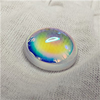
from Changchun Sunday Optics Co., Ltd.
Cylindrical lenses are generally used to focus incoming light onto a line or to change the aspect ratio of an image.They are usually linear and control the direction of the light beam.A cylindrical lens has a cylindrical surface that enables incident light to focus on a dimension and stretch the... [See More]
- Materials: Germanium; Sapphire; Optical glass, UVFS, Germanium, Silicon, CaF2, MgF2, ZnSe ZnS, Sapphire
- Surface Quality: 10-5 Scratch / Dig
- Lens Form: Plano-Convex
- Surface Flatness: λ/10
from HG Optronics, Inc.
Plano Concave Lenses are ideal for beam expansion, light projection, or for expanding an optical system's focal length. Plano Concave Lenses, which have one concave surface, are Optical Lenses with negative focal lengths. Plano-Concave Lenses should be shaped with the plano, or flat, surface towards... [See More]
- Materials: BK7 Glass; Calcium Fluoride; Germanium; Ultra-violet grade Fused Silica; Optical glass, BK7,H-K9L, Fused Silica, CDGM,Schott, OHARA, YAG CaF2,Germanium etc.
- Focal Length: -500 to -8
- Lens Form: Plano-Concave
- Diameter: 6 to 50.8
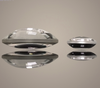
from Changchun Sunday Optics Co., Ltd.
Rod lenses are mainly used in Sensors, light guides, and endoscopes, laser systems. Sunday can make polishing either the end faces or the cylindrical faces depanding on customer's using.Rod lens can be two end faces polished, cylindrical faces polished, coating is available. [See More]
- Materials: Germanium; Sapphire; Optical glass, UVFS, Germanium, Silicon, CaF2, MgF2, ZnSe ZnS, Sapphire
- Surface Flatness: λ/10
- Surface Quality: 10-5 Scratch / Dig

from HG Optronics, Inc.
The Positive Meniscus Lenses are a convex-concave lens, but it is thicker at the center than at the edges. They are felt polished and are used universally in the ophthalmic industry where convention dictates that lens power be specified in Diopters. The Negative Meniscus Lenses are a convex-concave... [See More]
- Materials: BK7 Glass; Calcium Fluoride; Germanium; Ultra-violet grade Fused Silica; Optical glass, BK7,H-K9L, Fused Silica, CDGM,Schott, OHARA, YAG CaF2,Germanium etc.
- Lens Application: Infrared
- Lens Form: convex-concave
- Focal Length: -600 to 100