
Calcium Fluoride Spherical Lenses
Description
Calcium Fluoride Spherical Lenses are optical components designed to manipulate light through refraction. These lenses are crafted from calcium fluoride, a material known for its excellent transmission properties across a wide range of wavelengths, from ultraviolet (UV) to infrared (IR).
Working Principle
Calcium Fluoride Spherical Lenses operate by bending light rays that pass through them, focusing or dispersing the light to achieve the desired optical effect. The unique properties of calcium fluoride, such as its low refractive index and minimal optical dispersion, make these lenses particularly effective in reducing chromatic aberration, which is the failure of a lens to focus all colors to the same point. This characteristic is crucial for applications requiring high precision and clarity.
Applications
Calcium Fluoride Spherical Lenses are utilized in a variety of specialized fields. In the lithography industry, they are used as mirrors for excimer lasers, which are essential for producing microelectronic devices. In the realm of thermal imaging, these lenses are incorporated into devices that require cryogenic cooling to maintain low thermal noise levels. Additionally, they are employed in spaceborne spectrometers, such as the FLORIS spectrometer, to measure vegetation fluorescence from space, benefiting from their wide transmittance range and high refractive index homogeneity .
Advantages over other Spherical Lenses
Compared to other materials, Calcium Fluoride Spherical Lenses offer superior performance in terms of transmission range and resistance to thermal shock. Their ability to transmit light effectively from 350nm to 7µm makes them versatile for both UV and IR applications. Furthermore, their low optical dispersion reduces chromatic aberration, providing clearer and more accurate imaging .
Limitations
One of the primary limitations of Calcium Fluoride Spherical Lenses is their susceptibility to deformation under certain conditions. This can be mitigated through specific thermal treatments and polishing steps, but it remains a consideration for applications requiring high precision .
Considerations
When considering Calcium Fluoride Spherical Lenses, it is important to account for initial costs, which can be higher due to the specialized nature of the material and manufacturing process. However, their durability and resistance to water, chemicals, and heat can offset these costs over time by reducing the need for frequent replacements. Maintenance costs are generally low, but ensuring proper handling and storage is crucial to preserve their optical quality and performance .
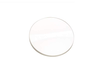
from Newport MKS
The CAPX10 is a Plano-Convex Infrared Lens, made of CaF2 material. It has a diameter of 12.7 mm, and an effective focal length of 25.4 mm. Calcium Fluoride lenses are an excellent choice of material for making lenses for UV to NIR wavelengths (180 nm - 8 μm). It has high average transmission... [See More]
- Materials: Calcium Fluoride; CaF2
- Diameter: 12.7
- Lens Form: Plano-Convex; Plano-Convex
- Center Thickness: 3

from Rocky Mountain Instrument/RMI Laser
Spherical Lenses are the most common lenses in optical systems design. RMI manufactures standard and custom spherical lenses from a wide range of materials with a wide range of size and shape specifications. Both sides can be coated with an RMI high efficiency narrowband, anti-reflective coating. [See More]
- Materials: BK7 Glass; Calcium Fluoride; Germanium; Sapphire; Zinc Selenide; Ultra-violet grade Fused Silica; Fused Silica, Cleartran, Barium fluoride, Magnesium Flouride, Silicon
- Surface Quality: 10-5 Scratch / Dig; 20-10 Scratch / Dig; 40-20 Scratch / Dig
- Lens Form: Plano-Convex; Plano-Concave; Convex-Convex; Concave-Concave
- Surface Flatness: λ/4; λ/10

from Thorlabs, Inc.
At Thorlabs, we constantly reinforce our desire to serve at the pleasure of our customers. From this comes our desire to be connected to our industry in a way that far exceeds what would typically be expected of a vendor. Thorlabs lives this core principle by seeking to enhance, at every turn, the... [See More]
- Materials: BK7 Glass; SF11 Glass; Calcium Fluoride; Zinc Selenide; Ultra-violet grade Fused Silica; Silicone
- Lens Application: Infrared; Visible; Ultraviolet
- Lens Form: Plano-Convex; Plano-Concave; Convex-Convex; Concave-Concave
- Focal Length: -1000 to 750

from Shanghai Optics
Calcium Fluoride is often used in spectroscopic windows and lenses due to its high transmission from 350nm to 7 µm. Calcium Fluoride is also commonly found in cryogenically cooled thermal imaging systems. Its low absorption and high damage threshold make it a popular choice for excimer laser... [See More]
- Materials: Calcium Fluoride
- Lens Application: Ultraviolet

from Rainbow Research Optics, Inc.
Your One-Stop Source for Spherical Lenses. From prototype to production, Rainbow Research Optics, Inc (RROI) designs, manufactures and coats spherical lenses. Spherical lenses are one of the most basic optical components to produce. With complete in-house capabilities, RROI is able to offer... [See More]
- Materials: BK7 Glass; SF11 Glass; Calcium Fluoride; Ultra-violet grade Fused Silica; VUV grade MgF2; IR grade CaF2; VUV grade CaF2
- Lens Application: Infrared; Visible; Ultraviolet
- Lens Form: Convex-Convex (optional feature); Concave-Concave (optional feature)
- Diameter: 3 to 406

from HG Optronics, Inc.
Double Concave Lenses are used in beam expansion, image reduction, or light projection applications. These lenses are also ideal for expanding the focal length of an optical system. Double Concave Lenses, which have two concave surfaces, are Optical Lenses with negative focal lengths. HG OPTRONICS... [See More]
- Materials: BK7 Glass; Calcium Fluoride; Germanium; Ultra-violet grade Fused Silica; Optical glass, BK7,H-K9L, Fused Silica, CDGM,Schott, OHARA, YAG CaF2,Germanium etc.
- Focal Length: -500 to -10
- Lens Form: Concave-Concave
- Diameter: 10 to 50
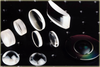
from Foctek Photonics, Inc.
FOCtek provides five kinds of spheric lens forms, or shapes, that determine the imaging Characteristics. of the lenses, they are plano-convex, plano-concave, Double-convex, Double-concave and Meniscus. Plano-convex lens has a positive focal length, which makes it ideal for collecting and focusing... [See More]
- Materials: BK7 Glass; Calcium Fluoride; Sapphire; H-K9, Fused Silica, N-SF10, Silicon
- Surface Quality: 10-5 Scratch / Dig; 60-40 Scratch / Dig
- Lens Form: Plano-Convex; Plano-Concave; Convex-Convex; Concave-Concave
- Surface Flatness: λ/4

from Fairfield Crystal Technology, LLC.
OPTICAL COMPONENT MANUFACTURING. Fairfield Crystal provides component manufacturing for your most challenging designs and applications. Combined with our expertise in crystal growth our component fabrication team is able to manufacture highly polished single crystal lenses, prisms, wedges,... [See More]
- Materials: Calcium Fluoride; Zinc Selenide
- Surface Quality: 10-5 Scratch / Dig; 20-10 Scratch / Dig; 40-20 Scratch / Dig; 60-40 Scratch / Dig; 80-50 Scratch / Dig
- Lens Application: Infrared; Visible; Ultraviolet
- Surface Flatness: λ/2; λ/4; λ/5; λ/8; λ/10; λ/20

from Intrinsic Crystal Technology Co., Ltd. (ICC)
ICC spherical technology includes PITECH, high speed and CNC method, which can meet the requirements of small quantity for precision control, and large quantity for cost. All processes are completed in the factory. Our spherical lenses are widely used in a variety of industrial and detection camera,... [See More]
- Materials: BK7 Glass; Calcium Fluoride; Germanium; Zinc Selenide; BAF2, Silicon
- Lens Application: Infrared; Visible
- Lens Form: Plano-Convex; Plano-Concave; Convex-Convex; Concave-Concave

from HG Optronics, Inc.
Double Convex Lenses are used in image relay applications, or for imaging objects at close conjugates. Double Convex Lenses have positive focal lengths, along with two convex surfaces with equal radii. Aberrations will increase as the conjugate ratios increase. Double-Convex Lenses are used in a... [See More]
- Materials: BK7 Glass; Calcium Fluoride; Germanium; Ultra-violet grade Fused Silica; Optical glass, BK7,H-K9L, Fused Silica, CDGM,Schott, OHARA, YAG CaF2,Germanium etc.
- Focal Length: 10 to 500
- Lens Form: Convex-Convex
- Diameter: 10 to 50