
Anode / Anode Material Electrodes and Electrode Materials
Last Updated: April 1, 2025
Description
Anode materials are crucial components in various electrochemical systems. They serve as the site where oxidation reactions occur, releasing electrons into the external circuit. These materials are typically made from metals or metal alloys, such as brass, bronze, cadmium, copper, lead, nickel, tin, or zinc, and are used in a variety of configurations depending on the specific application.
Working Principle
Anodes function by facilitating oxidation reactions, where the anode material loses electrons. This electron flow is essential for the operation of electrochemical cells, as it allows for the generation of electrical energy or the facilitation of chemical reactions. Mixed metal oxide (MMO) electrodes, for example, have an oxide coating over an inert metal or carbon core, which catalyzes electrolysis reactions. The inert core, often made of titanium, zirconium, niobium, or tantalum, provides structural integrity and corrosion resistance, making these anodes particularly useful in harsh environments.
Applications
Anodes are used in a wide range of applications. Plating anodes are primarily used in plating and electroplating processes, where they help deposit a layer of metal onto a substrate. Specific examples include the use of copper anodes in electroplating copper onto circuit boards or nickel anodes in nickel plating for corrosion resistance. MMO electrodes are commonly used in electrochlorination processes, which are essential for water treatment applications.
Advantages over other Electrodes and Electrode Materials
Anodes, particularly those made from mixed metal oxides, offer several advantages over other electrode materials. They provide excellent corrosion resistance, which is crucial in applications involving harsh chemical environments. The use of precious metal oxides in MMO electrodes enhances their catalytic activity, making them more efficient in facilitating electrochemical reactions compared to traditional metal anodes.
Limitations
Despite their advantages, anode materials also have limitations. The use of precious metals in MMO electrodes can significantly increase the cost, making them less economically viable for some applications. Additionally, the performance of anodes can degrade over time due to material wear and corrosion, necessitating regular maintenance and replacement.
Considerations
When selecting anode materials, several factors should be considered. Initial costs can be high, especially for anodes containing precious metals. Operating expenses may also be significant due to the need for regular maintenance and potential replacement costs. Durability is a key consideration, as anodes must withstand the specific chemical and physical conditions of their intended application. Accuracy in terms of maintaining consistent electrochemical performance is also important, particularly in precision applications such as electroplating.
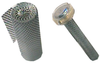
from Dexmet® Corporation, a part of PPG’s engineered materials division
The electrically active material used in the electrodes of most modern battery designs are powders and require a mechanical support structure to hold them in place during the manufacturing process. This support structure also functions as a current collector and provides the electrical connection... [See More]
- Type: Anode / Anode Material; Cathode / Cathode Material
- Applications: Battery or Fuel Cell (optional feature)
- Material: Aluminum (optional feature); Titanium (optional feature); Zinc (optional feature); Cu (optional feature)

from Belmont Metals, Inc.
Anodes: Electroplating. Featuring a wide variety of alloys and shapes for all electroplating processes including INCO Nickel, High Grade Zinc, CDA 101 Copper. The electroplating process consists of the immersion of an object to be coated in a bath containing an anode. The object itself functions as... [See More]
- Type: Anode / Anode Material
- Shape / Form: Cast Flat Top Anode Approx 1-1/4" Each
- Material: Brass
- OD / Width: 1.25

from Wallner Expac
For specialized applications such as microfiltration, battery technologies, and lightning strike protection, Wallner Expac manufactures its MicroForm® line of Micromeshes. Manufactured and engineered to precise specifications in our U.S.-based, ISO-9001 certified plants, our scalable manufacturing... [See More]
- Type: Anode / Anode Material; Cathode / Cathode Material
- Thickness: 0.0020
- Shape / Form: Diamond
- Plating / Coating: Nickel (optional feature)
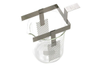
from Umicore Metal Deposition Solutions
Anodes for plating in beakers. Umicore anodes are available for beakers with volumes of 0.5, 1.0, 2.0, 3.0 and 5.0 litres. Special requests in view of dimensions and shape can be considered. The experience of Umicore Electroplating has shown that 90 per cent of all laboratory plating tests in the... [See More]
- Type: Anode / Anode Material
- Applications: Laboratory plating tests in standard beakers (e. g. for plating samples or small batches),

from CoorsTek
At sufficient temperatures, specialty compositions of ceramic membranes can be engineered to transport ions — allowing them to act as selective ion transport ceramics at a molecular level. Active ceramic membranes can be applied to a growing variety of gas-to-chemicals (GTCh), gas-to-liquids... [See More]
- Type: Anode / Anode Material
- Shape / Form: Custom / Application Specific
- Material: Ceramic
- Applications: Battery or Fuel Cell

from Indium Corporation
Indium Metal is extracted from indium bearing based metal ores and refined to various grades in high volume utilizing state of the art SPC controlled refining technologies. Rigorous quality standards and advanced analytical instrumentation such as ICP and GDMS, insures consistent product quality lot... [See More]
- Type: Anode / Anode Material
- Shape / Form: Bar Stock; Blank / Block

from Technic, Inc.
Wafer positioning racks and anode baskets are available in a variety of configurations from 50mm up to 300mm. Wafer racks are constructed of clear polycarbonate with titanium buss bar and rods. Titanium hylar coated buss rings hold wafers securely in place with magnet ring connections. Racks are... [See More]
- Type: Anode / Anode Material
- Shape / Form: Assembly

from Matexcel
Storage: Store at room temperature. Product overview: This product is a high energy density, long-life artificial graphite, primary/secondary particle composite product, which has excellent performance when used in NCA, high-nickel ternary, lithium cobalt oxide and other systems. Size: D50: ~15... [See More]
- Type: Anode / Anode Material
- Thickness: 5.91E-4
- Shape / Form: Powder
- Applications: Battery or Fuel Cell

from Umicore Metal Deposition Solutions
Very corrosion resistant anodes thanks to a platinum-niobium combination. In Cr6 free etching systems, functional components are chemically reduced and must be re-oxidized in a separate electrolysis cell at an insoluble anode surface. We also have the right anode for this electrochemical... [See More]
- Type: Anode / Anode Material
- Applications: Cr3 pre-treatment,
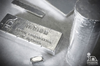
from Indium Corporation
Indium Corporation ® manufactures electroplating anodes in several forms: With an embedded hook. Bulk indium metal anodes. Ingots. Indium foil. Indium ribbon. Anodes with embedded hooks are made from Monel ® alloy. They are shaped dimensionally true so the anode rod will hang straight. [See More]
- Type: Anode / Anode Material
- Shape / Form: Bar Stock; Blank / Block
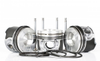
from Umicore Metal Deposition Solutions
The most efficient and eco-friendliest solution for hard chrome plating. Up to now, the standard in hard chrome plating has been lead anodes. They deliver sufficient, if not overly impressive, results and are comparatively cheap to procure. However, the market ’s requirements for anodes have... [See More]
- Type: Anode / Anode Material
- Applications: Shock absorbers, Compression rolls, Piston rings/rods, Hydraulic cylinders, Rod material,

from Umicore Metal Deposition Solutions
Optimal results with perfect price/performance ratio. Mixed metal oxide anodes (MMO) are dimensionally stable and suitable for a wide range of applications. The electrolytes can be alkaline-cyanide to strongly acidic. MMO anodes persuade with a perfect price/performance ratio. They have a low oxygen... [See More]
- Type: Anode / Anode Material
- Applications: Metal deposition out of sensitive electrolytes, Water treatment,