
Borescopes Information
Last revised: January 9, 2025
Reviewed by: Scott Orlosky, consulting engineer
Borescopes (or boroscopes) are optical inspection tools which consist of a hollow tube with an eyepiece and a lens at opposite ends.
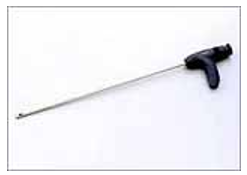
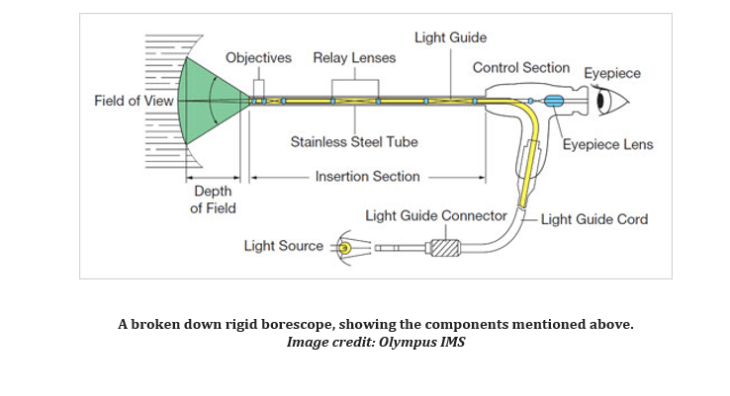
While borescopes are produced in many forms, all devices include a hollow tube, a light source, an eyepiece (which typically contains a means for magnification), and some method of relaying an image from the end of the scope to the eyepiece (often optical lenses or a video camera). They are primarily used for visual inspection of areas which are not accessible to other tools to check for cracks, coating defects, voids, burrs, corrosion, and other critical problem indicators. As noted below, borescopes can be flexible or rigid and use multiple means of transmitting images.
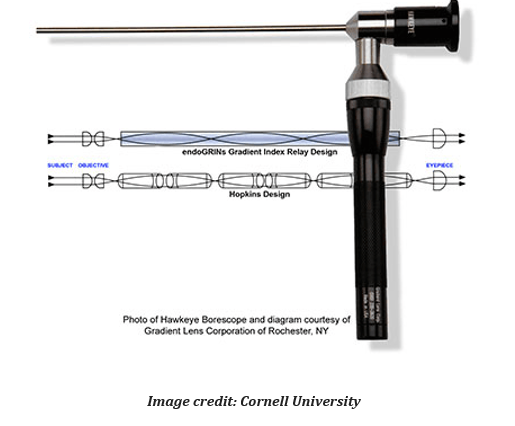
A typical rigid borescope is shown below. This particular device includes a flashlight adapter for providing image illumination, as shown in the image.
Applications
Borescopes are useful for inspecting bores and cavities of many different devices and types of equipment, including those listed below.
- Turbines
- Cast parts
- Building interiors (forensics and general inspection)
- Automotive components - fuel injectors, engine cylinders, motors, and manifolds
- Tanks and boilers
- Pumps and valves
- Specialized military use - gun bore inspection, surveillance
Types of Borescopes
Borescopes may be classified in two different ways: by tube rigidity or image relay type.
Rigid vs. Flexible
Borescope tubing may be either rigid or flexible. Rigid borescopes include some of the most inexpensive designs, as they typically involve only a hollow tube, eyepiece, a light source, and one or more relay lenses. Lenses used in rigid borescopes are typically achromats, GRIN lenses, or Harold Hopkins designs (more detail below). While rigid borescopes are economical and effective, their grave disadvantage is that their viewing is effectively limited to a straight line. When inspecting certain entities, such as straight pipes, engine cylinders, and fuel injectors, rigid borescopes are effective.
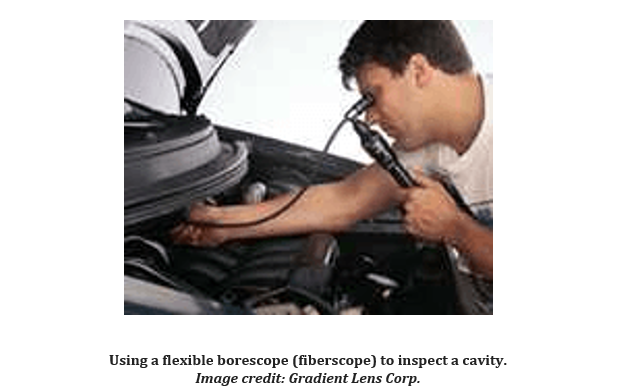
Flexible borescopes are much more versatile than rigid types. Because they require additional means for transmitting an image to the eyepiece, they are more expensive to manufacture and purchase. Flexible types include fiberscopes and borescopes, as described below.
Specialty borescopes called endoscopes are used to examine cavities within the human body. While these are typically flexible devices, some rigid ones are produced.
Relay Type
Relay optics determine a borescope's image quality.
Rigid Relay Types
Rigid borescopes may use one of three different relay types for image transmission.
Achromats are double lenses (doublets) which are designed to correct chromatic and spherical aberration. These are cost-effective options but are typically used only in large-diameter borescopes.
Hopkins design is a system devised by Harold Hopkins, a British physicist, which involves the precise placement of numerous polished glass tubes in place of tiny lenses. Hopkins relays result in excellent image quality for medium-diameter borescope applications but are tedious to produce and maintain, given the delicate nature of the optics involved.
Gradient index (GRIN) relays operate in a similar fashion to Hopkins designs, but are simpler to produce and use. For example, a single GRIN rod is capable of performing the same function as 24 separate Hopkins tubes. Therefore, gradient index optics result in the best combination of quality and cost. This relay type is typically used for small- to medium-diameter borescopes.

Flexible Relay Types
Flexible relay types include optical fibers and digital video signals. These devices are further described in the Fiberscope Specification Guide and the Videoscope Specification Guide, respectively.
Specifying Borescopes
When selecting borescopes for a specific application, specifications about the device's tube and field of view must be considered.
Borescope manufacturers typically provide the tube's diameter and length. These two values must be carefully considered after determining the size and depth of the object or space to be inspected.
Viewing Angle and Field of View
A borescope's viewing angle (or direction of view [DOV]) and field of view (FOV) are both specified in degrees. The viewing angle describes the device's view relative to an imaginary longitudinal line through the scope's tube.
A borescope which views straight-on has a 0° viewing angle, while a scope which provides a view out the side of the tube is said to have a 90° angle. Borescopes with the latter viewing angle are able to inspect piping and other narrow cavities with greater detail than a straight-ahead scope.
Field of view can be thought of as a cone extending beyond the tip (or distal end) of the tube. As shown below, a 30° field of view results in a narrowly-focused image, while a 120° view is much broader but is capable of less magnification. Selecting an FOV is dependent upon the inspected object's distance from the tip of the tube; as distance from the tip increases, the field of view angle should decrease (and therefore magnification and image quality will increase).
Depth of field (DOF) is a specification closely related to FOV. DOF describes the distance from the tip of the tube to the furthest object which appears clearly in focus.
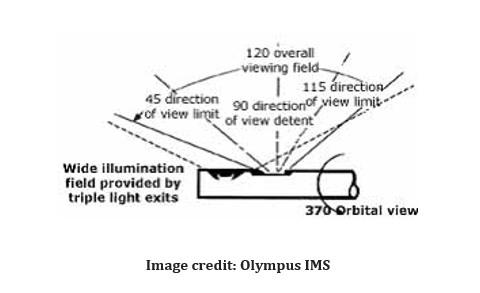
The image below shows both of these angles for a side-view borescope. This particular device is adjustable between 45° and 115° DOV, with a possible FOV of 120°. Note that, as marked, a 90° DOV points straight up, and a 115° DOV points somewhat backwards from the distal end of the tube at left.
Standards
Borescopes may be produced, tested, and used based on various standards or specifications. Some common standards include:
SAE International - ARP4078B —Storage, care, and use of borescopes and fiberscope’s
NPFC - A-A-59883—Borescopes
TM 9-4933-200-35—Pullover gages/borescopes
Borescopes FAQS
What are the key factors to consider when specifying a borescope?
When specifying a borescope for a particular engineering task, one should consider the following characteristics.
Type of Borescope
Rigid vs. Flexible: Rigid borescopes are typically used for inspecting straight pipes and bores, while flexible borescopes, such as fiberscopes and videoscopes, are more versatile and suitable for inspecting hard-to-reach cavities.
Viewing Angle and Field of View (FOV)
The viewing angle or direction of view (DOV) and the field of view determine how much of the area can be inspected. A 0° viewing angle provides a straight-on view, while a 90° angle allows for side viewing, which can be beneficial for inspecting narrow cavities.
Tube Specifications
Consider the diameter and length of the borescope's tube. These specifications should match the size and depth of the object or space to be inspected. Tube diameter is usually specified in millimeters, while length can be in millimeters, meters, or feet
Image Quality and Relay Optics
The type of relay optics used in the borescope affects image quality. For example, achromats are cost-effective options that correct chromatic and spherical aberration but are typically used in large-diameter borescopes.
Illumination
The brightness of the illuminating light source is important, especially in low-light environments. While manufacturers may not specify brightness, the reflectivity and lighting conditions of the inspection area should be considered.
Application-Specific Requirements
Consider any specific requirements of the application, such as the need for high-temperature resistance or compatibility with existing equipment, which may necessitate custom designs or features.
These factors can help guide the selection of a borescope that is well-suited to the specific needs of an engineering task.
What are some common applications for videoscopes and fiberscopes?
Videoscopes and fiberscopes are versatile tools used in various engineering and medical applications due to their ability to inspect hard-to-reach areas. Here are some common applications.
Videoscopes
Turbine Inspection: Videoscopes are commonly used for inspecting cavities and crevices in turbines, particularly in aircraft engines. They allow for visual inspection of internal components by threading the scope through access points like ignitor ports or specially-designed borescope access hatches.
Pipes and Valves: They are used to inspect the internal conditions of pipes and valves, helping to identify blockages, corrosion, or other issues.
Automotive Components: Videoscopes assist in inspecting automotive parts, such as engines and exhaust systems, without the need for disassembly.
Building Inspections: They can be used to inspect structural elements within buildings, such as walls and ceilings, for signs of damage or wear.
Fiberscopes
Nondestructive Testing (NDT): Fiberscopes are frequently used in NDT applications to inspect hard-to-reach cavities in various equipment types, including engines, tanks, and vessels.
Pipe and Turbine Inspection: Similar to videoscopes, fiberscopes are used to inspect pipes, turbines, and other equipment for maintenance and troubleshooting purposes.
Retrieval of Loose Components: When used with retrieval tools, fiberscopes can help locate and remove loose components from machinery or equipment.
These applications highlight the importance of selecting the appropriate type of scope based on the specific requirements of the inspection task.
How do the viewing angle and field of view affect the performance of a borescope?
Viewing Angle
The viewing angle, also known as the direction of view (DOV), is specified in degrees and describes the scope's view relative to an imaginary longitudinal line through its tube. A 0° viewing angle provides a straight-on view, which is suitable for inspecting areas directly in front of the borescope. In contrast, a 90° viewing angle allows for side viewing, which is beneficial for inspecting narrow cavities and areas that are not directly in line with the borescope's insertion path.
Field of View (FOV)
The field of view is also specified in degrees and determines how much of the area can be inspected at once. A larger FOV allows for a broader view of the inspection area, which can be advantageous for quickly assessing larger spaces or identifying issues that might be missed with a narrower view. However, a wider FOV might reduce the level of detail visible in the image, so there is often a trade-off between FOV and image detail.
These factors are essential in selecting the appropriate borescope for a specific task, as they determine the scope's ability to effectively inspect and capture images of the target area.
What are the key design considerations when selecting a borescope?
Type of Borescope
Rigid vs. Flexible: Rigid borescopes are typically used for inspecting straight pipes and bores, while flexible borescopes, such as fiberscopes and videoscopes, are more versatile and suitable for inspecting hard-to-reach cavities.
Viewing Angle and Field of View (FOV)
As previously noted, a 0° viewing angle provides a straight-on view, while a 90° angle allows for side viewing; useful for inspecting narrow cavities.
Tube Specifications
Consider the diameter and length of the borescope's tube. These specifications should match the size and depth of the object or space to be inspected. Tube diameter is usually specified in millimeters, while length can be in millimeters, meters, or feet.
Image Quality and Relay Optics
The type of relay optics used in the borescope affects image quality. For example, achromats are cost-effective options that correct chromatic and spherical aberration but are typically used in large-diameter borescopes.
Illumination
The brightness of the illuminating light source is important, especially in low-light environments. While manufacturers may not specify brightness, the reflectivity and lighting conditions of the inspection area should be considered.
Application-Specific Requirements
Consider any specific requirements of the application, such as the need for high-temperature resistance or compatibility with existing equipment, which may necessitate custom designs or features.
These considerations will help guide the selection of a borescope that is well-suited to the specific needs of an engineering task.
How does the choice of relay optics impact the performance of a borescope?
Image Quality
Relay optics transmit the image from the distal end of the borescope to the eyepiece or camera. The quality of these optics directly affects the clarity and resolution of the image.
Achromats, which are double lenses (doublets), are commonly used in borescopes to correct chromatic and spherical aberrations. This helps produce clear and accurate images, especially in large-diameter borescopes.
Cost Considerations
The type of relay optics used can also influence the cost of the borescope. Achromats are considered cost-effective options, but they are typically used only in larger borescopes due to their design and functionality.
Application Suitability
The choice of relay optics should align with the specific requirements of the application. For instance, if high image quality is critical for the inspection task, selecting borescopes with advanced relay optics that minimize aberrations would be beneficial.
How do illumination options affect borescope performance?
Brightness and Visibility
The brightness of the illuminating light source is one of the most critical elements to consider, especially in low-light environments. Adequate illumination ensures that the inspection area is well-lit, allowing for clear visibility of details and potential defects within the inspected object or space.
Reflectivity and Lighting Conditions
The reflectivity of the surfaces being inspected and the existing lighting conditions in the inspection area should be considered when selecting a borescope. These factors influence the effectiveness of the illumination and, consequently, the quality of the image captured by the borescope.
Design Considerations
In some cases, borescopes are designed to maximize light throughput by modifying or removing certain components, such as fiber optic illumination parts, to accommodate larger aperture optics. This design choice can enhance the brightness and clarity of the images captured by the borescope.
Borescopes Media Gallery
References
GlobalSpec—Small Diameter/High Temp Borescope
Olympus—What are industrial rigid borescopes?
Images credit: