
Gas Springs Information
Last revised: January 9, 2025
Gas springs provide controlled motion and speed for elements, such as lids and doors, that open and close. They typically rely on the fluid dampening of a gas such as nitrogen in the cylinder.

Performance Specifications
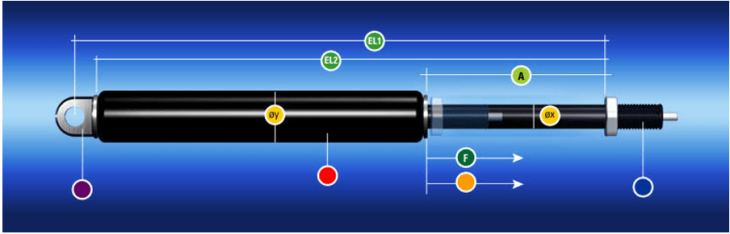
Important performance specifications to consider when searching for gas springs include absorber stroke, compressed length, extended length, maximum force (P1), and maximum cycles per minute.
- Absorber or spring stroke is the difference between fully extended and fully compressed position.
- Compressed length is the minimum length of shock (compressed position).
- Extended length is the maximum length of shock (extended position).
- The maximum rated force for shock absorber or damper, referred to as the P1 force.
- The maximum cycles per minute are the rated frequency of compression/extension cycles.
Compression or Extension
The absorption or damping action for gas springs can be compression or extension.
- In a compression gas spring the shock absorption or dampening occurs in the compression direction.
- In an extension gas spring the shock absorption or dampening occurs in the extension direction.
Physical Specifications
Important physical specifications to consider when searching for gas springs include the cylinder diameter or maximum width, the rod diameter, mounting, and body material.
- The cylinder diameter or maximum width refers to the desired diameter of housing cylinder.
- The rod diameter refers to the desired diameter of extending rod.
Mounting Choices
Mounting choices include ball and socket, rod end, clevis, eyelet, tapered end, threaded, and bumper or rod end unattached.
- A ball and socket is a spherical bearing with bore that allows for multi-axis rotation. A ball end is a ball and socket (spherical bearing) with an integral threaded stud.
- Clevis pins include mating fork mounts.
- Eyelets are round holes at the absorber ends for mounting.
- On a tapered end mounting the cylinder side has tapered end for snug fit into mounting hole.
- In a threaded mounting the ends or body have standard threads for mounting or accessory attachment.
- In a bumper or rod end unattached mounting the rod is not attached to the load, but has a bumper on end to engage moving load.
Body Materials
Choices for body materials include aluminum, steel, stainless steel, and thermoplastic.
Features
Common features for gas springs include adjustable configuration, reducible, locking, and valve.
- An adjustable configuration allows the user to fine tune desired damping, either continuously or at discrete settings.
- A reducible gas spring has an adjustment style for gas shocks in which gas is let out to permanently reduce force capacity.
- In a locking gas spring the position can be locked at ends or in the middle of stroke.
- Valves can be included for fluid absorbers, a valve or port, which can be used to increase or decrease fluid volume or pressure.
Standards
The ISO (International Organization for Standardization) provides the standard ISO 11901-1:2003 which specifies the dimensions, nominal initial forces, and type of gas springs.
Gas Springs FAQs
How do the physical specifications of gas springs impact their functionality in engineering designs?
The physical specifications of gas springs significantly impact their functionality in engineering designs. Here are some key aspects:
Material Composition: Gas springs are commonly made from materials like stainless steel and thermoplastic, which influence their durability, corrosion resistance, and suitability for different environments.
Temperature Sensitivity: The force exerted by a gas spring can change with temperature variations. For each 10°C change, the force can alter by approximately 3.3%, which is crucial for applications requiring precise force control.
Force and Size Customization: The size and extension force of gas springs can be customized according to specific requirements. This flexibility allows engineers to design gas springs that meet the precise needs of their applications.
Adjustability and Locking Features: Some gas springs come with adjustable configurations and locking mechanisms, which are beneficial for applications where the load or position needs to be varied or secured.
Damping Characteristics: The damping characteristics of gas springs can affect their performance by causing vibrations or noise. Adjustments in installation or attachments can help mitigate these effects.
Interchangeable End Fittings: The ability to interchange end fittings allows for greater flexibility in installation and application, making gas springs adaptable to various engineering designs.
These specifications enable gas springs to be tailored for specific applications, enhancing their functionality and effectiveness in engineering designs.
What are the materials used in gas springs and their impact on performance?
The materials used in gas springs play a crucial role in their performance and suitability for various applications. Here are some insights based on the information available:
Material Composition
Gas springs are commonly made from materials such as stainless steel and thermoplastic.
Stainless Steel: Known for its durability and corrosion resistance, stainless steel is often used in environments where the gas spring may be exposed to moisture or corrosive elements. This enhances the longevity and reliability of the gas spring in harsh conditions.
Thermoplastic: This material is typically used for components that require flexibility and resistance to wear. Thermoplastics can also offer weight reduction, which is beneficial in applications where minimizing weight is critical.
Impact on Performance
Durability and Corrosion Resistance: The choice of material directly affects the gas spring's ability to withstand environmental factors. Stainless steel, for example, provides excellent resistance to rust and corrosion, making it suitable for outdoor or marine applications.
Temperature Sensitivity: The performance of gas springs can be influenced by temperature changes. While the material itself may not directly affect temperature sensitivity, the overall design and material choice can help mitigate these effects. For instance, certain materials may better insulate the gas spring, reducing the impact of temperature fluctuations on force exertion.
Flexibility and Customization: The use of thermoplastic materials allows for more design flexibility, enabling the customization of gas springs to meet specific application requirements. This can include adjustments in size, force, and damping characteristics.
These material choices and their properties ensure that gas springs can be tailored to meet the demands of various engineering applications, enhancing their functionality and effectiveness.
How do temperature variations affect gas spring performance?
Temperature variations can significantly affect the performance of gas springs. Here are some key points to consider:
Force Variation with Temperature
The force exerted by a gas spring is sensitive to temperature changes. Specifically, for each 10°C change in temperature, the force can alter by approximately 3.3%. This means that in environments with fluctuating temperatures, the performance of the gas spring can vary, which is crucial for applications requiring precise force control.
Material Influence
While the material itself may not directly affect temperature sensitivity, the overall design and material choice can help mitigate these effects. For instance, certain materials may better insulate the gas spring, reducing the impact of temperature fluctuations on force exertion.
Operating Temperature Range
Gas springs are designed to operate within specific temperature ranges. For example, some industrial gas springs have an operating temperature range of -4 to 176° F. Staying within this range ensures optimal performance and longevity of the gas spring.
These factors highlight the importance of considering temperature variations when selecting and designing gas springs for specific engineering applications.
What are some common applications where temperature sensitivity of gas springs is a critical factor?
Temperature sensitivity of gas springs is a critical factor in several applications where precise force control is essential. Here are some common applications:
Automotive Industry
Gas springs are used in vehicle hoods, trunks, and tailgates. Temperature variations can affect the ease of opening and closing these components, especially in regions with extreme weather conditions.
Industrial Equipment
In industrial settings, gas springs are used in machinery and equipment that may operate in environments with fluctuating temperatures. This can impact the performance and reliability of the equipment.
Aerospace Applications
Gas springs are used in aircraft for various purposes, including seat adjustments and cargo doors. The temperature sensitivity is crucial due to the wide range of temperatures experienced during flight.
Medical Devices
Certain medical devices that rely on gas springs for movement or positioning may be sensitive to temperature changes, affecting their precision and functionality.
Consumer Electronics
Gas springs in adjustable monitors or other electronic devices can be affected by temperature changes, impacting their adjustability and user experience.
These applications highlight the importance of considering temperature sensitivity when selecting and designing gas springs for specific engineering applications.
How can engineers mitigate the effects of temperature sensitivity in gas springs?
To mitigate the effects of temperature sensitivity in gas springs, engineers can consider several strategies.
Choose materials that offer better insulation properties to reduce the impact of temperature fluctuations on the gas spring's force exertion. While the material itself may not directly affect temperature sensitivity, it can help mitigate these effects.
Design gas springs to operate within specific temperature ranges. For instance, some industrial gas springs have an operating temperature range of -4 to 176°F, ensuring optimal performance within these limits.
Customize the size and extension force of gas springs according to specific requirements. This flexibility allows engineers to design gas springs that can better handle temperature variations.
Make small changes in the installation or attachments to help avoid vibrations and noise caused by damping characteristics, which can be exacerbated by temperature changes.
These strategies can help engineers design gas springs that maintain consistent performance despite temperature variations, enhancing their reliability and effectiveness in various applications.
How does the choice of end fittings affect the performance of gas springs in varying temperatures?
The choice of end fittings can influence the performance of gas springs, particularly in varying temperatures. Here are some general insights based on the context of gas springs:
Interchangeability and Flexibility
Interchangeable end fittings allow for greater flexibility in installation and application, making gas springs adaptable to various engineering designs. This adaptability can be beneficial in environments with temperature fluctuations, as it allows for adjustments that might mitigate temperature-related performance issues.
Installation Adjustments
The choice of end fittings can affect how a gas spring is installed. Proper installation can help manage the damping characteristics of gas springs, which might be influenced by temperature changes. Adjustments in installation or attachments can help avoid vibrations and noise, which can be exacerbated by temperature variations.
Material and Design Considerations
While the documents do not specifically mention the material of end fittings, choosing materials that offer better insulation properties could potentially help in reducing the impact of temperature fluctuations on the gas spring's performance.
Gas Springs Media Gallery
References
GlobalSpec—Important Advice for Installation of Gas Springs
GlobalSpec—Gas Spring: Force Diagram
Image Credit: