ABOUT THIS CHAPTER
In this chapter, you will learn about solid-state lasers, in which
light is emitted by atoms embedded in a crystal, glass, or other
transparent solid. After first explaining the general operation of
solid-state lasers, this chapter describes the most important types,
starting with the classic ruby laser, then covers neodymium and a
family of related materials in which laser emission can be tuned
across a range of wavelengths. The chapter also covers fiber lasers
and amplifiers, in which the solid-state laser material is drawn
into an optical fiber.
8.1 WHAT IS A SOLID-STATE LASER?
The first step in understanding solid-state lasers is to recognize
that the laser community uses a different definition of "solidstate"
than electronic engineers or physicists. Solid-state physics
occurs in a solid. Solid-state circuits are semiconductor devices
that conduct electricity and perform electronic operations. In electronics,
semiconductors are considered solid-state devices in contrast
to vacuum tubes, in which electrons move through a vacuum
rather than through a solid. However, in the laser world semiconductor
devices do not count as solid-state lasers because they operate
in fundamentally different ways, as you will learn in Chapter
9.
The fundamental difference arises from the way the laser
medium is excited. The solids in solid-state lasers transmit light that excites atoms contained within the solid to produce a population
inversion on the laser transition. The light-absorbing atoms
are dispersed in a solid that transmits the pump light that excites
the atoms. In Maiman's first laser, the light-absorbing atoms were
chromium dispersed in aluminum oxide (sapphire). Normally, the
light-absorbing atoms are present only in small concentrations,
added intentionally to an otherwise transparent solid as dopants.
Solids transparent at optical wavelengths are insulators and conduct
electrical current poorly. In contrast, semiconductor lasers
are excited by an electrical current, as described in Chapter 9.
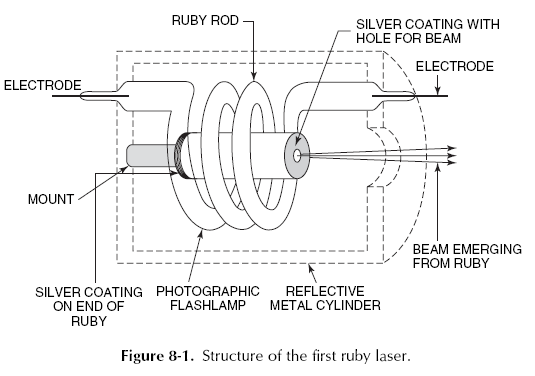
Chromium atoms both absorb and emit light in ruby, and give
the crystal its red color. The simple design of Maiman's laser,
shown in Figure 8-1, clearly illustrates the principles of solid-state
laser operation. Light from the spring-shaped flashlamp illuminated
the little ruby rod that it surrounded. Green and violet light
passed through the red-colored ruby crystal and excited chromium
atoms. Some chromium atoms then emitted red light, which
stimulated other excited chromium atoms to release their excess
energy as identical red photons. Thin metal films coated on the
ends of the rod formed a reflective laser cavity, with the beam
emerging through a small hole in the middle of the film on one
end. The laser pulsed only during the flash of the flashlamp.
Today's diverse family of solid-state lasers have been refined
in many ways, but the same principles underlie their operation.
Photons from an external source excite atoms dispersed in a solid
host, producing a population inversion. Spontaneous emission
triggers a cascade of stimulated emission, which oscillates between
the mirrors in a laser cavity, and produces a beam.
Solid-state lasers can take various forms. Typically, the solid is
shaped into a rod, but sometimes it may be a slab with mirrors
arranged so light oscillates through the slab. The solid also may be in
the form of an optical fiber, essentially a very long and very thin rod.
Solid-state lasers can be made from many different materials,
although in practice most solid-state lasers are made of a few materials
selected because they perform best as lasers. The lasers may
be packaged with nonlinear devices that generate shorter-wavelength
harmonics of the fundamental laser frequency. Solid-state
laser materials can be used in laser amplifiers as well as in oscillators,
particularly for optical amplification in fiber-optic communication
systems, or to produce short high-energy pulses.
The technology has come a long way since Maiman's first
laser. Sales of solid-state and fiber lasers were close to $1.2 billion
dollars in 2006, according to Laser Focus World. That total is more
than five times the dollar value of solid-states lasers sold in 1991,
and that number is expected to continue rising.
Let us look first at some general issues of materials and optical
pumping, then turn to specific types of solid-state lasers.
© 2008

 TABLE OF CONTENTS