9.3.2 Semiconductor Diode Laser Concepts
It was a surprisingly small step from the first efficient LEDs to the
first semiconductor lasers. Both were demonstrated in 1962 in the
same material, gallium arsenide, and the LED was almost overlooked
in the race to make the first semiconductor laser.
The simplest diode lasers are structurally similar to LEDs.
Both generate light from recombination of electron hole pairs at
a forward-biased junction. Below the laser threshold, both generate
spontaneous emission with an intensity that depends on the
drive current. However, diode lasers have reflective surfaces that
create optical feedback. The feedback has little impact when
drive current is below the point needed to produce a population
inversion, but is critical in crossing the threshold for laser operation.
At low drive current, electron hole pairs (excitons) release
their energy by spontaneous emission, as in an LED. As the drive
current increases, it produces more electron hole pairs that emit
light spontaneously, increasing the likelihood that a spontaneously
emitted photon will encounter and stimulate emission from an
exciton that has yet to release its extra energy. Once the drive current
reaches a high enough level, it produces a population inversion
between the exciton state (the upper laser level) and the
atoms with the extra electron bound in the valence band (the
lower laser level). That leads to a cascade of stimulated emission
as the laser crosses the threshold.
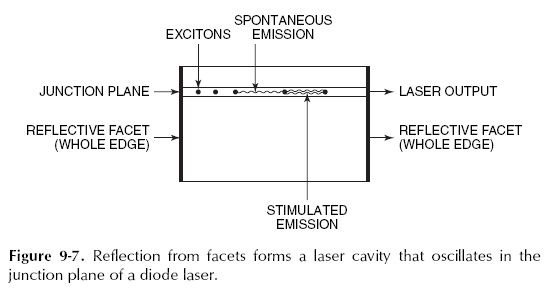
Because the excitons are in the thin layer of the junction
plane, stimulated emission is most likely to build up along the
junction. For this reason, the reflective cavity is aligned along the
junction plane, with reflective surfaces perpendicular to the junction,
as shown in Figure 9-7.
Semiconductors have a high refractive index, so an uncoated
solid air interface reflects much of the stimulated emission back
into the semiconductor, as shown in Equation 5-4, providing feedback
for the laser resonator. The large population inversion at high
drive current makes gain high in semiconductor lasers, so cavities
only a few hundred micrometers long can sustain oscillation. One
facet often is coated to reflect all the incident light, so all the stimulated
emission emerges from the other end, as shown in Figure
9-7.
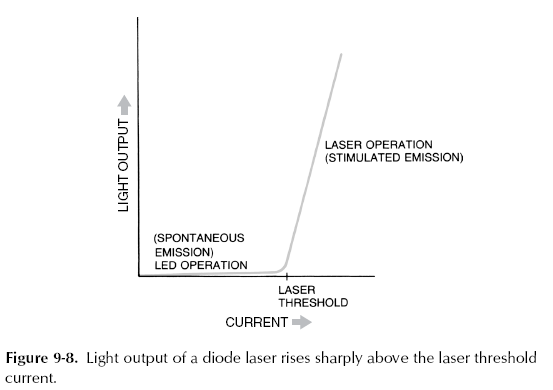
Diode lasers have a well-defined threshold at which their output
shifts from low-power spontaneous emission to higher-power
laser operation, as shown in Figure 9-8. Below the threshold, the
diode operates as a relatively inefficient LED. Above the threshold,
the diode operates as a laser, converting a much higher portion
of the input electrical power into light energy, as shown by
the steeper slope.
Threshold current is an important factor in semiconductor
laser performance. Electrical power needed to reach the threshold
current winds up as heat that must be dissipated in the laser. So
does the fraction of above-threshold current that is not converted
into light. The extra heat is not just wasted power; it also degrades
laser performance and tends to shorten its lifetime, so lowerthreshold
lasers tend to have longer lifetimes. High currents also
stress the laser by putting highly concentrated power through the
junction; this is measured as threshold current density (threshold
current divided by the junction area operating as a laser) rather
than the total threshold current.
Diodes built to operate as lasers are inherently less efficient as
LEDs than those built to operate as LEDs. A main reason is packaging.
As you saw earlier, spontaneous emission is emitted in all directions,
and LEDs are designed to collect as much as possible of
this light. However, edge-emitting diode lasers like the one shown
in Figure 9-7 collect light only from the junction layer at the edge
of the chip, a much smaller area. When a diode built to operate as
a laser is below threshold, only a small fraction of the spontaneous
emission it generates emerges through the edge of the junction
plane; the rest is trapped within the packaged device.
© 2008

 TABLE OF CONTENTS


