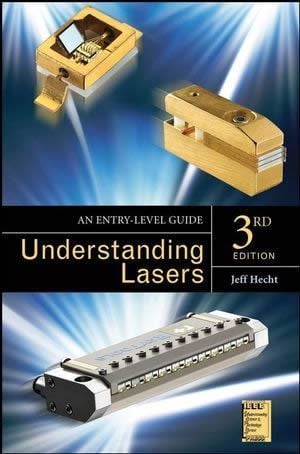
Understanding Lasers

Chapter 9.14: What Have We Learned?

9.14 WHAT HAVE WE LEARNED?

  • Semiconductor lasers are often called diode lasers or laser diodes.
  • Diodes are two-terminal electronic devices that conduct current in one direction.
  • Electrons in the valence band are bound to atoms. Electrons in the conduction band are free to move in a solid.
  • Holes are vacancies in the valence band of a semiconductor. A hole moves when an electron from another atom fills the empty space in the valence band.
  • n-type semiconductors are doped with elements that release electrons to carry current. p-type semiconductors are doped with elements that form holes.
  • Current flow through a forward-biased diode causes electrons to recombine with holes at the junction layer between n- and p-type semiconductors.
  • An electron–hole pair called an exciton exists briefly before the electron drops into the hole and releases its energy.
  • LEDs emit recombination radiation when spontaneous emission occurs at the junction layer. The emission wavelength depends on the band-gap energy of the material.
  • Semiconductors need a direct band gap to emit light efficiently. Silicon has an indirect band gap so it does not emit light efficiently.
  • III–V compounds such as GaAs. InGaN, and InGaAsP are called compound semiconductors.
  • Diode lasers are structurally similar to LEDs, but have resonant cavities. When drive current exceeds a threshold value, they generate stimulated emission.
  • The current needed to reach laser threshold winds up as waste heat in a diode laser.
  • A single-heterojunction laser improves confinement by depositing layers with different compositions on top of each other.
  • Room-temperature continuous-wave emission requires a double heterojunction, with a junction layer of one composition sandwiched between layers of other composition.
  • Confining light emission to a narrow stripe in the junction plane improves diode laser performance.
  • Gain guiding confines current flow through a diode laser to guide light in a narrow stripe in the junction layer.
  • Index guiding surrounds the active stripe in the junction laser with lower-index material to guide light.
  • High-power diode lasers require either a broad stripe or arrays of many parallel stripes.
  • A simple edge-emitting diode laser oscillates in the junction plane, with the edges of the chip serving as the resonator mirrors. This design is called a Fabry–Perot laser, because it uses two parallel surfaces as a resonator.
  • The emitting area of a narrow-stripe laser is a few micrometers wide and a fraction of a micrometer high.
  • Distributed-feedback and distributed Bragg-reflection lasers confine diode-laser oscillation to a narrow range of wavelengths.
  • External-cavity lasers confine light to a narrow range of wavelengths that can be tuned by adjusting the optics.
  • Semiconductor optical amplifiers resemble diode lasers, but reflection from edge facets is suppressed so they can amplify light but not oscillate.
  • A VCSEL is a diode laser that oscillates in a vertical cavity, perpendicular to the junction plane, and emits light from its sur-face. VCSELs are inexpensive to fabricate and package, and have low drive currents.
  • Horizontal-cavity surface-emitting lasers oscillate in the junction plane, but include optics that direct their output through the surface of the chip.
  • A quantum well is a double heterojunction thinner than 50 nm which confines electrons tightly in a layer with lower band-gap energy than the surrounding layers.
  • A quantum cascade laser extracts energy in a series of steps from electrons passing through a series of quantum wells.
  • Edge-emitting diode lasers have a large beam divergence, but external optics can focus the light into a narrow beam.
  • Defects occur in diode lasers if the atomic spacing in successive layers is not matched or managed carefully.
  • GaInN diodes emit blue, violet, and ultraviolet light.
  • Diode lasers with active layers of AlGaInP emit at 635 nm in the red.
  • GaAlAs lasers emit in the near-infrared; their main use is in CD and CD-ROM players. They also can emit high power for pumping other lasers at 808, 830, and 850 nm.
  • InGaAs lasers emitting at 980 nm are widely used as pump lasers.
  • InGaAsP diode lasers emit at wavelengths of 1100 to 1650 nm; their main applications are in fiber-optic communication systems.
  • Packaging determines the function of a diode laser; it often costs more than making the laser itself.
  • Diode lasers are simple to modulate by changing their drive current.

WHAT'S NEXT?

In Chapter 10, we will describe types of lasers that are in development or do not fit into the three major categories of Chapters 7, 8, and 9. These include tunable organic-dye lasers, free-electron lasers, extreme-ultraviolet lasers, and silicon lasers.

QUIZ FOR CHAPTER 9

1. In order to make a good diode laser, a material should be

a. A semiconductor with an indirect bandgap

b. A semiconductor with a direct bandgap

c. An insulator with an indirect bandgap

d. An insulator with a direct bandgap

e. A conductor

2. Which of the following is a quaternary III–V semiconductor?

a. InGaAsP

b. PbSnSSe

c. GaAlAs

d. GaAs

e. NSbAsP

3. The active layer of a diode laser is made of Ga0.8Al0.2As. What percent of the atoms in the active layer are of each element?

a. 80% gallium, 20% aluminum, 100% arsenic

b. 80% gallium, 20% aluminum, 0% arsenic

c. 40% gallium, 10% aluminum, 50% arsenic

d. 20% gallium, 80% aluminum, 100% arsenic

e. 33% gallium, 33% aluminum, 33% arsenic

4. An exciton is

a. A free electron in the conduction band

b. A free electron in the valence band

c. The energy released by the combination of an electron and a hole

d. An electron–hole pair in an excited state because the electron has not combined with the hole

e. A molecule that exists only in the excited state.

5. What gives a double-heterostructure laser better efficiency than a homostructure laser?

a. Reverse biasing

b. Better confinement of conduction electrons

c. Restriction of current flow to the active layer

d. Lower levels of spontaneous emission

e. A homostructure laser is more efficient

6. Which type of laser is made from GaAlAs?

a. Fabry–Perot edge emitter

b. VCSEL

c. External cavity

d. Distributed feedback edge emitter

e. All of the above

7. Which kind of laser has the shortest optical cavity?

a. Helium–neon gas

b. Edge-emitting diode

c. External cavity diode

d. VCSEL

e. Impossible to tell

8. You are building a video player for use with high-definition disks. What kind of laser do you need?

a. InGaN diode

b. GaAlAs edge emitter

c. GaAlAs VCSEL

d. InGaAsP distributed feedback

e. Quantum cascade

9. A semiconductor has a band gap of 1.5 electron volts. At what wavelength will it emit light if it can operate as a laser?

a. 1500 nm

b. 1000 nm

c. 827 nm

d. 667 nm

e. 333 nm

10. Which type of semiconductor lasers emit a single longitudinal mode?

a. Homojunction

b. Buried-heterostructure

c. Monolithic arrays

d. Distributed-feedback

e. Those built for compact disc players

11. What family of diode lasers emits the shortest wavelength?

a. GaAlAs

b. AlGaInP

c. InGaAsP

d. GaInN

e. AlGaN

12. What type of diode laser is most likely to be used in a red laser pointer?

a. GaAlAs

b. AlGaInP

c. InGaAsP

d. GaInN

e. AlGaN

UNLIMITED FREE
ACCESS
TO THE WORLD'S BEST IDEAS

SUBMIT
Already a GlobalSpec user? Log in.

This is embarrasing...

An error occurred while processing the form. Please try again in a few minutes.

Customize Your GlobalSpec Experience

Category: Diode Lasers
Finish!
Privacy Policy

This is embarrasing...

An error occurred while processing the form. Please try again in a few minutes.