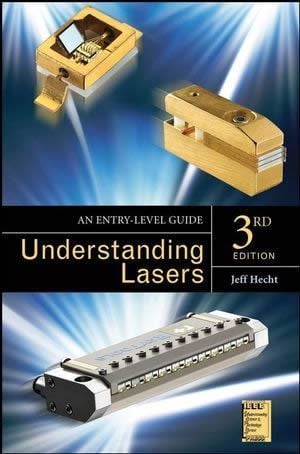
Understanding Lasers

Chapter 9.1: Basics Of Semiconductor Diode Lasers

9.1 BASICS OF SEMICONDUCTOR DIODE LASERS

Like the other lasers described so far, a semiconductor diode laser generates a beam when spontaneous emission triggers a cascade of stimulated emission from a population inversion inside a resonant optical cavity. As in a gas laser, the excitation energy comes from an electric current passing through the laser material, but in a semiconductor diode laser the laser material is a solid with a particular internal structure that produces and traps a population inversion.

The structure is called a diode and it is formed within the semiconductor by depositing layers with different compositions. We will get into the details later. It is possible to produce stimulated emission from semiconductors in other ways, such as stimulated Raman scattering in silicon (described in Chapter 10) but virtually all semiconductor lasers now in use rely on an internal diode to produce a population inversion. Thus, you really do not have to call them semiconductor diode lasers; you can call them semiconductor lasers, diode lasers, or laser diodes. Those terms are interchangeable. Sometimes, the devices are just called diodes in a context in which it is clear that they are lasers, such as a diodepumped solid-state laser.

Diode lasers are close cousins of the light-emitting diodes or LEDs. LEDs came first, initially discovered in 1907 by Henry J. Round, and in the 1920s independently rediscovered and studied in much more detail by Oleg Losev in the Soviet Union. More LED demonstrations followed as physicists learned more about semiconductor physics, especially in the 1950s, but their emission was feeble. That changed in 1962 with the dramatic demonstration of bright infrared emission from gallium arsenide by Robert Rediker at the MIT Lincoln Laboratory. Within a few months, Robert Hall of General Electric in Schenectady, NY, had built on that to make the first diode lasers, and Nick Holonyak Jr., working for GE in Syracuse, NY, had made the first bright visible LEDs.

The fundamental difference between the LEDs and the diode lasers was that diode lasers were driven much harder with a much higher current. The first diode lasers were operated at the cryogenic temperature of liquid nitrogen, 77°K ( 196° C or 321°F). It took years to develop versions that could generate a continuous beam at room temperature, and more years to improve them so they could operate for more than a few seconds or minutes at a time. But diode laser technology has followed the growth of other semiconductor technologies, and their technology has improved tremendously.

Diode lasers are now a pervasive if hidden technology. Laser Focus World estimated that in 2006 over 800 million diode lasers were sold around the globe, accounting for nearly $3 billion in sales. You use them when you listen to CDs, watch DVDs, or make long-distance calls that pass through fiber-optic cables. Diode lasers emitting violet light were a key advance behind the new generation of HD video players. People routinely use diode-laser pointers to highlight presentations and play with their cats. Diode laser scanners read price codes in stores and align construction equipment.

UNLIMITED FREE
ACCESS
TO THE WORLD'S BEST IDEAS

SUBMIT
Already a GlobalSpec user? Log in.

This is embarrasing...

An error occurred while processing the form. Please try again in a few minutes.

Customize Your GlobalSpec Experience

Category: Fiber Lasers
Finish!
Privacy Policy

This is embarrasing...

An error occurred while processing the form. Please try again in a few minutes.