Biotreatment of Industrial Effluents

Intended for practicing environmental engineers and technologists from any industry, this book discusses the treatment procedures using biochemical means for all types of solid, liquid and gaseous contaminants.
 TABLE OF CONTENTS
 There are several equations available for estimating the mass transfer and diffusion coefficients.
Mass transfer coefficient from fluid to solid or gas to liquid for particles less than 0.60 mm
| (4-30) |  |
where k L is in m/s, diameter in m, density in kg/m 3, viscosity in kg/m s, and g in m/s 2.
Gas to liquid mass transfer for bubble swarms when d < 2.5 mm
| (4-31) |  |
Gas to liquid mass transfer for bubble swarms when d > 2.5 mm
| (4-32) |  |
Mass transfer into a free liquid surface or into a falling film
| (4-33) |  |
where ? is the surface renewal time, which is the stream depth per average velocity. Another equation is,
| (4-34) |  |
Mass transfer during aeration in lakes and ponds (O'Connor-Dubbins)
| (4-35) |  |
Mass transfer correlation for an agitated aerated vessel under turbulent conditions (Calderbank) (Bailey and Ollis, 1977)
| (4-36) | 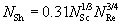 |
(In this equation, we use the impeller diameter as the characteristic length for N Re)
Mass transfer correlation for agitated vessel under turbulent conditions [Kulov et al. (1983)]
Taking the power input by the agitator into consideration
| (4-37) |  |
where the power number N P is
| (4-38) | 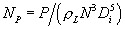 |
(In this equation, the characteristic length of N Sh is the tank diameter and the characteristic length of N Re is the impeller diameter.)
Interfacial area per unit liquid volume (a)
| (4-39) |  |
Equations are found in the literature for calculating ? g, bubble volume to reactor volume...