Biotreatment of Industrial Effluents

Intended for practicing environmental engineers and technologists from any industry, this book discusses the treatment procedures using biochemical means for all types of solid, liquid and gaseous contaminants.
 TABLE OF CONTENTS
 When liquid organic pollutants are released into the soil, they can become physically bound within the soil phase, as well as at the pore spaces that separate the soil particles from one another. A single particle has an intraparticle porosity that characterizes the internal structure of the particle as well as an interparticle porosity that characterizes the packing of the particles.
An empirical relation that can be used to estimate effective diffusivity ( D eff) of liquid through soil bed is (Middleman, 1998)
| (4-72) | 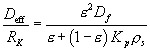 |
| where R K = | retardation of diffusion due to the absorption of the solute on the surface of the particle |
| ? s = | mass density of the solid phase |
| K p = | equilibrium constant relating the contaminant concentration in the fluid and solid phases |
| D f = | diffusion coefficient of the contaminant in the fluid phase |
| ? = | bed porosity |
The amount of contaminant remaining in a spherical particle at any time t is obtained by integrating the diffusion equation as follows:
| (4-73) |  |
where M o is the initial amount of contaminant and R is the radius of the particle. Except for early times, the second and subsequent terms in the infinite series can be neglected, which gives rise to a simple equation
| (4-74) | 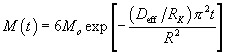 |
This equation can also be used to estimate the time required for the concentration of the contaminant to reach half its initial value.
Municipal landfills require construction of a barrier...