Biotreatment of Industrial Effluents
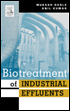
Intended for practicing environmental engineers and technologists from any industry, this book discusses the treatment procedures using biochemical means for all types of solid, liquid and gaseous contaminants.
 TABLE OF CONTENTS
 Most of the biomass occurs as floes or aggregates, and the concentration of biomass is referred to as mixed liquid suspended solids (MLSS, ~1500 to 3500 mg/L). Sludge loading (kg BOD/m 3/day, ~0.4 to 1.2) is the ratio of biodegradable organic material to active biomass (Forster, 1990).
| (4-47) |  |
| (4-48) | 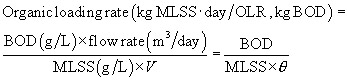 |
For high rate, conventional, and extended aeration systems, the OLR varies between 0.5 and 5, 0.25 and 0.45, and 0.05 and 0.2, respectively.
| (4-49) |  |
Minimum sludge age compatible with nitrification (t *)
| (4-50) |  |
Daily carbonaceous oxygen requirement (kg/day)
| (4-51) |  |
Air requirement for extended aeration
| (4-52) |  |
Air requirement for extended aeration and burning only carbonaceous material at 20 C
| (4-53) |  |
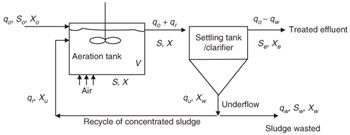
The mass balance equation for biomass production in a completely stirred, tank-activated sludge reactor is (see Fig. 4-2):
| (4-54) | 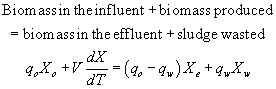 |
Biomass production rate
| (4-55) | 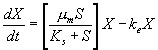 |
When the biomass amount in the inflow and outflow liquid streams is negligible, then X o and X e = 0. Equation (4-54) becomes
| (4-56) | 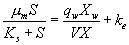 |
Mass balance equation for substrate utilization
| (4-57) |  |
Substrate consumption rate
| (4-58) | 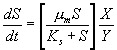 |
Since degradation is taking place only in the aeration tank,
| (4-59) |  |
Substituting Eqs. (4-58) and (4-59) into Eq. (4-57)
| (4-60) | 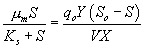 |
Cell residence time (sludge age)
| (4-61) |  |
or
| (4-62) | 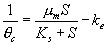 |
Hydraulic residence time
| (4-63) |  |
Combining Eqs. (4-56) and (4-60), i.e., cell and substrate utilization balances,
| (4-64) | 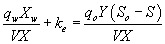 |
Substituting Eqs. (4-61) and (4-63) into (4-64) gives an equation for the amount of biomass in the exit stream of the activated sludge plant.
| (4-65) | 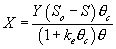 |
Volumetric loading rate