Biotreatment of Industrial Effluents
Intended for practicing environmental engineers and technologists from any industry, this book discusses the treatment procedures using biochemical means for all types of solid, liquid and gaseous contaminants.
 TABLE OF CONTENTS
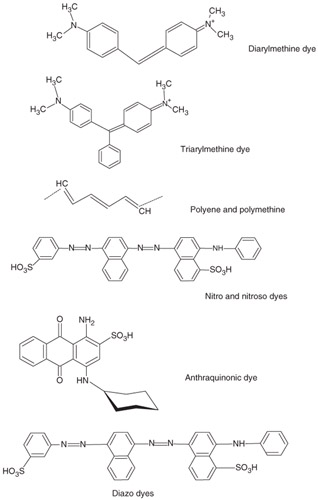
 Dyestuffs can be classified according to their origin, chemical and/or physical properties, or characteristics related to the application process. Another categorization is based on the applications sector (e.g., inks, disperse dyes, pigments, or vat dyes). A systematic classification of dyes according to chemical structure is the color index, namely, nitroso, nitro, monoazo, disazo, trisazo, polyazo, azoic, stilbene, carotenoid, diphenylmethane, triarylmethane, xanthene, acridine, quinoline, methine, thiazole, indamine/indophenol, azine, oxazine, thiazine, sulfur, lactone, aminoketone, hydroxyketone, anthraquinone, indigoid, phthalocyanine, natural, oxidation base, and inorganic. Synthetic dyes are also classified according to their most predominant chemical structures, namely, polyene and polymethine, diarylmethine, triarylmethine, nitro and nitroso, anthraquinone, and diazo (Fig. 10-1). Approximately 10,000 different dyes and pigments are manufactured worldwide with a total annual market of more than 7 10 5 tonnes per year. There are several structural varieties of dyes, such as acidic, reactive, basic, disperse, azo, diazo, anthraquinone-based, and metal-complex dyes. They all absorb light in the visible region. Untreated dye effluent is highly colored and hence reduces sunlight penetration, preventing photosynthesis. Many dyes are toxic to fish and mammalian life, inhibit growth of microorganisms, and affect flora and fauna. They are also carcinogenic in nature and hence can cause intestinal cancer and cerebral abnormalities in fetuses.
The physical and chemical methods for the treatment of dye-containing effluent includes physicochemical flocculation combined with flotation, electroflotation, flocculation with Fe(II)/Ca(OH) 2, membrane filtration, electrokinetic coagulation, electrochemical destruction, ion-exchange, irradiation, photochemical precipitation,...