Biotreatment of Industrial Effluents
Intended for practicing environmental engineers and technologists from any industry, this book discusses the treatment procedures using biochemical means for all types of solid, liquid and gaseous contaminants.
 TABLE OF CONTENTS
 The simple kinetic equation for a single substrate reaction is
| (4-15) |  |
where n is the order of the reaction and k is the rate constant, which is a function of temperature and could be of the form
| (4-16) |  |
The rate equation for enzyme catalyzed reactions is given by the Michaelis Menten equation.
| (4-17) |  |
The rate equation changes in the presence of inhibitors. The most important of these are as follows.
| (4-18) | 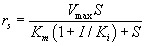 |
Uncompetitive inhibitor
| (4-19) | 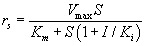 |
Noncompetitive inhibitor
| (4-20) | 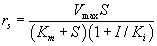 |
Substrate inhibition (uncompetitive)
| (4-21) | 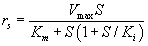 |
Product inhibition (uncompetitive)
| (4-22) | 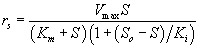 |
There are several forms of modified Monod equation; the basic one is:
| (4-23) |  |
Rapid growth
| (4-24) | 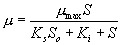 |
Teisser model
| (4-25) | 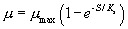 |
Moser model
| (4-26) |  |
Contois model The Contois model takes biomass concentration into account.
| (4-27) |  |
Substrate and product inhibition models are also possible. They are similar to the enzyme rate equations. If two substrates are rate limiting, then the Monod equation becomes:
| (4-28) | 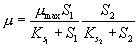 |
Growth rate equation with maintenance of the cells
| (4-29) | 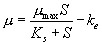 |