DCOM Explained
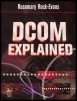
The "big picture" of DCOM architecture for system designers and technical managers.
 TABLE OF CONTENTS
 All Object Request Brokers (ORB) conforming to CORBA use the same conceptual model. Microsoft's model of object-based processing COM is, however, different, and it is worthwhile understanding the concepts Microsoft uses, as it affects the capabilities of DCOM and the sorts of application a developer can build.
Thus, although it is not, strictly speaking, essential that the developer has a detailed grasp of the concepts used in COM, a basic understanding helps in any discussion. This chapter thus provides a brief overview of the main concepts used.
We will be introducing other concepts such as Outgoing Interfaces, IDispatch, and all other terms in the context of the functions they provide. The terms you see here are the basic building blocks on which everything in COM is based.
GUIDs are Globally Unique Identifiers for things. The things in question can be any thing interfaces, classes/components, programs, and so on, but within DCOM they are used specifically for classes and interfaces. The important point about a GUID is that it is unique, whereas a name (however long) may not be. The number used is a 128 bit/16 byte value which is created automatically by DCOM services. Microsoft's GUIDGEN.EXE and UUIDGEN.EXE both automatically generate GUIDs.
Different mechanisms can be used to create the identifier so that it is unique, but the one most commonly employed uses a combination of the IEEE machine identifier of the host used to create the thing, (this is obtained from the network card and subsequently has no meaning), the...