DCOM Explained

The "big picture" of DCOM architecture for system designers and technical managers.
 TABLE OF CONTENTS
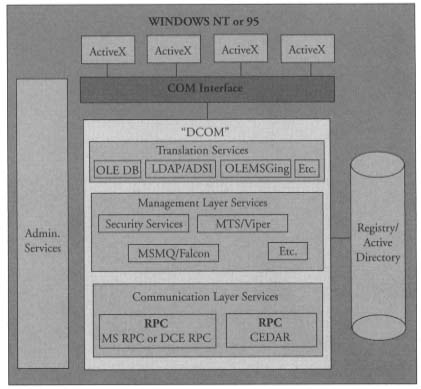
 We saw in the last chapter that all applications access the services of DCOM as well as the components themselves using the same class and interface-based approach. In other words, all the services are accessed via a common object-based interface or "API." The API is implemented in the COM Library.
In this chapter we explore this concept further by looking at the concept of the client at the two ways in which interfaces can be used, via the use of stubs and VTables or using Type Libraries. We will also be briefly covering the IDispatch interface.
Microsoft uses the term application in a generic way to mean either a client or a server or a collection of clients and servers. All applications (clients or servers) have some set responsibilities whether they are clients or servers. On application startup they must:
verify the COM library version
and initialize the COM library
On application shutdown they must "uninitialize" the COM library.
All applications must also perform their own memory management during processing, and we will see how DCOM provides commands to help in this in a later chapter.
A client is any application requesting for an object to be instantiated via DCOM/COM; as such the term "client" really describes a role. Clients are responsible for:
creating instances of objects
initializing the object via its Initialization interface
and calling the object's release function when the client has finished with it
A server is a...