DCOM Explained
The "big picture" of DCOM architecture for system designers and technical managers.
 TABLE OF CONTENTS
 DCOM is entirely reliant on MS RPC to provide its distributed capability. In fact, it is MS RPC which turns COM into DCOM. Understanding what this key service does is thus essential even if much of what is achieved is done "under the covers."
A Remote Procedure Call (RPC) is a procedure that, when called, executes a function on a remote machine and returns with results from that function when completed. Remote Procedure Calls mimic the structure of a simple C function call, with the function's name, its arguments when called, and its returned value or structure, giving the programmer the impression that he or she is making calls to routines on the same processor.
From the programmer's perspective, calls to routines on other systems seem no different to calls to, for example, local C functions. If processes communicate using RPCs, one process calls another process as though it were a part of the original process's code.
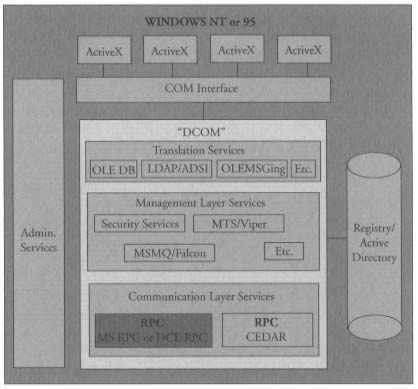
Distributed processes pass control and data between application processes just as they do for local procedure calls. But there is an obvious difference between the way distributed applications pass data when compared to single processor systems.
Single processor systems can pass data between procedures by passing only the address or the name of the data item. Because they run in the same execution environment, the data is effectively shared because storage format and data structures are usually the same. The data in this...