DCOM Explained
The "big picture" of DCOM architecture for system designers and technical managers.
 TABLE OF CONTENTS
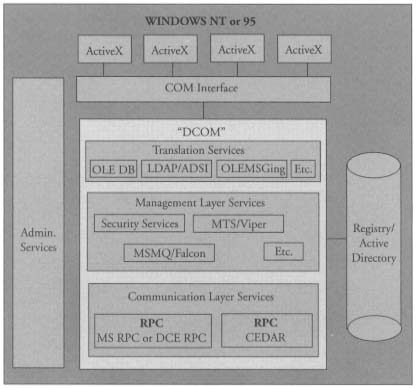
 DCOM is embedded within Windows NT and 95, and, at the moment, it is possible to classify what constitute DCOM services and which services are not DCOM, but provided by the operating system. But some services we need to build distributed applications are classified by Microsoft itself as services of Windows NT and not DCOM. This confuses the issue.
We use DCOM to build distributed applications. But, in reality, what we see is that occasionally we are going to have to go outside DCOM and use Windows NT to get the services we need. Knowing about these services is important because if we start to build applications for other platforms, DCOM ports may not provide these services for us.
Even if equivalent services are provided, the suppliers of these ports may be using a different mechanism, which may in turn require changes to our code and limit portability.
Windows NT was first launched in July 1993; since then Microsoft has sold well over 15 million copies. It was designed by Dave Cutler, creator of Digital's highly successful VMS operating system for the VAX, and it provided, on its launch, full 32 bit operation, preemptive multitasking, virtual memory, C2 level security, and built-in networking.
At the time I wrote this, Windows NT was on version 4, but the key and most important version of Windows NT to affect DCOM will be Windows NT version 5.0. Windows NT 5.0 is due to...