DCOM Explained

The "big picture" of DCOM architecture for system designers and technical managers.
 TABLE OF CONTENTS
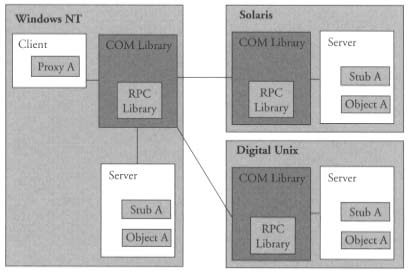
 The generic term for any piece of code that can be invoked via methods and interfaces is termed a component, and we have seen that automation servers are one form of component capable of being run on many platforms. Clearly, they might need to be recompiled to get them to work on other platforms using native compilers (we will see why I have said "might" later on in this chapter), but in essence the same component source code should be capable of being compiled to run on any platform supporting DCOM without needing to be changed (ActiveX components, however, are of special importance to DCOM because they work over the Internet and are intended to be portable).
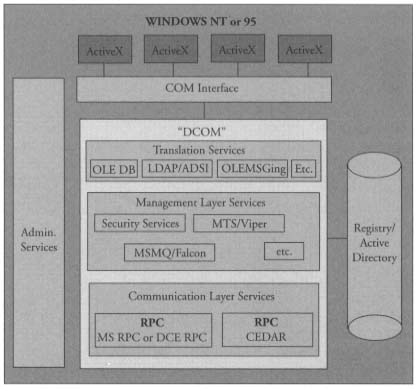
ActiveX components are a key part of Microsoft's strategy. ActiveX components are like normal components in all respects, but as we have seen, they can be distinguished from normal components because they are intended to be portable.
In the future it should be possible to run ActiveX components on any platform supporting DCOM, as long as they use the COM model, communicate using DCOM services, and use the Microsoft Interface Definition Language to describe the interfaces.
A developer should be able to describe the interfaces and generate the source code for the stubs and proxies, write the component in his language of choice, then deploy it on the platform of choice by using the native compiler to convert the source code to executable code.