DCOM Explained
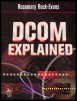
The "big picture" of DCOM architecture for system designers and technical managers.
 TABLE OF CONTENTS
 One of the key things that developers have always found is that computing consists of a combination of the execution of functions and the manipulation of data. Some functions only need data stored in the computer's memory, but the majority of functions need data that is stored safely on a secure storage medium a storage medium that can maintain a record of the data even after the computer has been switched off. All simple and obvious stuff, of course, but object-based computing is based on the idea that data is stored with function, which makes any data access that much more complex. In this chapter,we will find that OLE DB is just one of a number of features within DCOM that enable a developer to access data data in a variety of formats.
There are four main methods that can be used to store data generated or used by a program:
Memory
Shared memory
Distributed shared memory
File systems and DBMSs
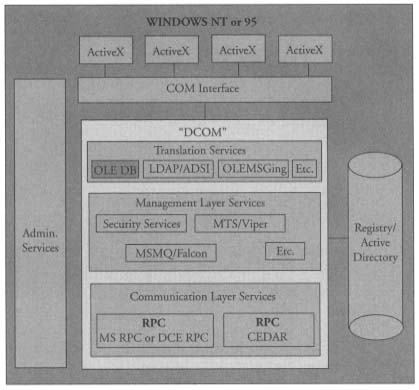
A single program can store temporary data in its memory, two or more programs on a single machine can store their shared data in shared memory, two or more programs on different machines can store their data in distributed shared memory, and one or more programs can store its data in a file system or DBMS.
As we saw in chapter 10, DCOM supports the storage of data in memory and shared memory via Windows NT. Windows NT...