VLSI Testing: Digital and Mixed Analogue/Digital Techniques

The final objective of testing is to prevent faulty circuits from being assembled into equipment, or to detect circuits which have developed faults subsequent to their commitment. Our discussions here are largely in the context of LSI/VLSI circuits, but apply equally to digital systems which have comparable controllability and observability limitations.
Digital testing may be considered to have three purposes, namely:
fault detection, which is to discover something wrong in a circuit or system, ideally before it has caused any trouble;
physical fault location, which is the location of the source of a fault within an integrated circuit;
component fault location, which is the location of a faulty component or connection within a completed system.
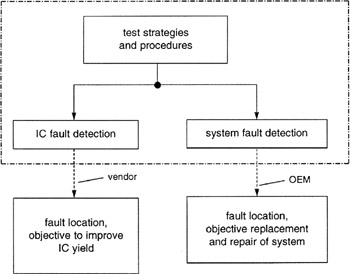
This is illustrated in Figure 3.1. It is the top part of this diagram with which we will be largely concerned; fault location is IC or system specific, requiring intimate knowledge and expertise covering the particular component or system.
Every digital test involves a situation such as shown in Figure 3.2a. At each step every output test response has to be checked, which requires prior knowledge of what the fault-free responses should be. For very simple circuits; particularly of SSI and MSI complexity, the procedure shown in Figure 3.2b may be used; for more complex circuits the...