Materials Selection in Mechanical Design, Third Edition
Chapter 3: Engineering Materials and their Properties

3.1 Introduction and Synopsis

Materials, one might say, are the food of design. This chapter presents the menu: the full shopping list of materials. A successful product one that performs well, is good value for money and gives pleasure to the user uses the best materials for the job, and fully exploits their potential and characteristics. Brings out their flavor, so to speak.

The families of materials metals, polymers, ceramics, and so forth are introduced in Section 3.2. But it is not, in the end, a material that we seek; it is a certain profile of properties the one that best meets the needs of the design. The properties, important in thermo-mechanical design, are defined briefly in Section 3.3. It makes boring reading. The reader confident in the definitions of moduli, strengths, damping capacities, thermal and electrical conductivities and the like, may wish to skip this, using it for reference, when needed, for the precise meaning and units of the data in the Property Charts that come later. Do not, however, skip Sections 3.2 it sets up the classification structure that is used throughout the book. The chapter ends, in the usual way, with a summary.

3.2 The Families of Engineering Materials

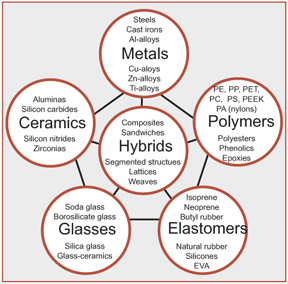
It is helpful to classify the materials of engineering into the six broad families shown in Figure 3.1: metals, polymers, elastomers, ceramics, glasses, and hybrids. The members of a family have certain features in common: similar properties, similar processing routes,...

UNLIMITED FREE
ACCESS
TO THE WORLD'S BEST IDEAS

SUBMIT
Already a GlobalSpec user? Log in.

This is embarrasing...

An error occurred while processing the form. Please try again in a few minutes.

Customize Your GlobalSpec Experience

Category: Industrial Ceramic Materials
Finish!
Privacy Policy

This is embarrasing...

An error occurred while processing the form. Please try again in a few minutes.