Materials Selection in Mechanical Design, Third Edition

6.9: Materials for Seals

6.9 Materials for Seals

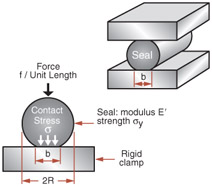
A reusable elastic seal consists of a cylinder of material compressed between two flat surfaces (Figure 6.15). The seal must form the largest possible contact width, b, while keeping the contact stress, ?, sufficiently low that it does not damage the flat surfaces; and the seal itself must remain elastic so that it can be reused many times. What materials make good seals? Elastomers everyone know that. But let us do the job properly; there may be more to be learnt. We build the selection around the requirements of Table 6.15.

Table 6.15: Design requirements for elastic seals

Function

Elastic seal

Constraints

  • Limit on contact pressure

  • Low cost

Objective

Maximum conformability to surface

Free variables

Choice of material


Figure 6.15: An elastic seal. A good seal gives a large conforming contact-area without imposing damaging loads on itself or on the surfaces with which it mates.

The Model.

A cylinder of diameter 2 R and modulus E, pressed on to a rigid flat surface by a force f per unit length, forms an elastic contact of width b (Appendix A) where

(6.30)

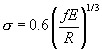
This is the quantity to be maximized: the objective function. The contact stress, both in the seal and in the surface, is adequately approximated (Appendix A) by

(6.31)

The constraint: the seal must remain elastic, that is, ? must be less than the yield or failure strength, ? f, of the material of which it is...

UNLIMITED FREE
ACCESS
TO THE WORLD'S BEST IDEAS

SUBMIT
Already a GlobalSpec user? Log in.

This is embarrasing...

An error occurred while processing the form. Please try again in a few minutes.

Customize Your GlobalSpec Experience

Category: Dynamic Seals
Finish!
Privacy Policy

This is embarrasing...

An error occurred while processing the form. Please try again in a few minutes.