Materials Selection in Mechanical Design, Third Edition

Appendix B: Material Indices

B.1 Introduction and Synopsis

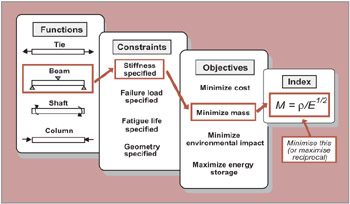
The performance, P, of a component is characterized by a performance equation. The performance equation contains groups of material properties. These groups are the material indices. Sometimes the "group" is a single property; thus if the performance of a beam is measured by its stiffness, the performance equation contains only one property, the elastic modulus E. It is the material index for this problem. More commonly the performance equation contains a group of two or more properties. Familiar examples are the specific stiffness, E/ ?, and the specific strength, ? y/ ? (where ? y is the yield strength or elastic limit, and ? is the density), but there are many others. They are a key to the optimal selection of materials. Details of the method, with numerous examples are given in Chapters 5 and 6 and in the book Case Studies in Materials Selection. [1] This appendix compiles indices for a range of common applications.

[1]M. F. Ashby and D. Cebon (1995) Case Studies in Materials Selection, Granta Design Ltd, Rustat House, 62 Clifton Road, Cambridge CBI 7EG, UK (www.grantadesign.com).

B.2 Uses of Material Indices

Material Selection.

Components have functions: to carry loads safely, to transmit heat, to store energy, to insulate, and so forth. Each function has an associated material index. Materials with high values of the appropriate index maximize that aspect of the performance of the component. For reasons given in Chapter...

UNLIMITED FREE
ACCESS
TO THE WORLD'S BEST IDEAS

SUBMIT
Already a GlobalSpec user? Log in.

This is embarrasing...

An error occurred while processing the form. Please try again in a few minutes.

Customize Your GlobalSpec Experience

Category: Metal Sheet
Finish!
Privacy Policy

This is embarrasing...

An error occurred while processing the form. Please try again in a few minutes.