Materials Selection in Mechanical Design, Third Edition

These case studies illustrate how the techniques described in the last chapter really work. They are deliberately simplified to avoid clouding the illustration with unnecessary detail. The simplification is rarely as critical as it may at first appear: the choice of material is determined primarily by the physical principles of the problem, not by details of geometry. The principles remain the same when much of the detail is removed so that the selection is largely independent of these.
The methods developed in Chapter 9 are so widely useful that they appear in the case studies of later chapters as well as this one. A reference is made to related case studies at the end of each section.
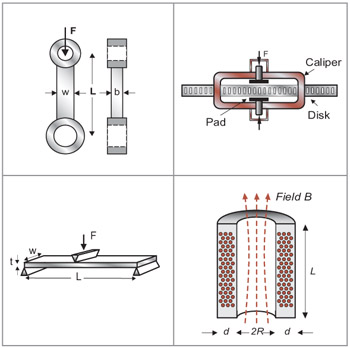
A connecting rod in a high-performance engine, compressor, or pump is a critical component: if it fails, catastrophe follows. Yet to minimize inertial forces and bearing loads it must weigh as little as possible, implying the use of light, strong materials, stressed near their limits. When minimizing cost is the objective, con-rods are frequently made of cast iron because it is so cheap. But what are the best materials for con-rods when the objective is to maximize performance ?
Table 10.1 summarizes the design requirements for a connecting rod of minimum weight with two constraints: that it must carry a peak load F without failing either by fatigue or by buckling elastically. For simplicity, we assume that...