Materials Selection in Mechanical Design, Third Edition

Why do horse breeders cross a horse with a donkey, delivering a mule? Why do farmers prefer hybrid corn to the natural strain? Mules, after all, are best known for their stubbornness, and like hybrid corn they cannot reproduce, so you have to start again for each generation. So why? Because, although they have some attributes that are less good than their forebears, they have others hardiness, strength, resistance to disease that are better. The botanical phrase "hybrid vigor" sums it up.
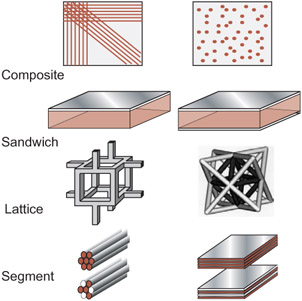
So let us explore the idea of hybrid materials combinations of two or more materials assembled in such a way as to have attributes not offered by either one alone (Figure 13.1, central circle). Like the mule, we may find that some attributes are less good (e.g. the cost), but if the ones we want are better, something is achieved. Particulate and fibrous composites are examples of one type of hybrid, but there are many others: sandwich structures, lattice structures, segmented structures, and more. Here we explore ways of designing hybrid materials, emphasizing the choice of the components, their configuration, their relative volume fraction, and their scale. The new variables expand design space, allowing the creation of new "materials" with specific property profiles. Table 13.1 lists the ingredients.
| Components | The choice of materials to be combined |
| Configuration | The shape and connectivity of the components |
| Relative volumes | The volume fraction of each component |