Materials Selection in Mechanical Design, Third Edition

6.4: Materials for Table Legs

6.4 Materials for Table Legs

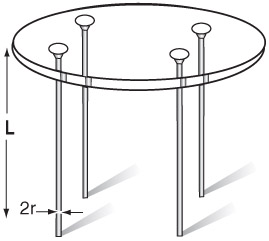
Luigi Tavolino, furniture designer, conceives of a light-weight table of daring simplicity: a flat sheet of toughened glass supported on slender, un-braced, cylindrical legs (Figure 6.5). The legs must be solid (to make them thin) and as light as possible (to make the table easier to move). They must support the table top and whatever is placed upon it without buckling (Table 6.5). What materials could one recommend?

Table 6.5: Design requirements for table legs

Function

Column (supporting compressive loads)

Constraints

  • Length L specified

  • Must not buckle under design loads

  • Must not fracture if accidentally struck

Objective

  • Minimize the mass, m

  • Maximize slenderness

Free variables

  • Diameter of legs, 2 r

  • Choice of material


Figure 6.5: A light-weight table with slender cylindrical legs. Lightness and slenderness are independent design goals, both constrained by the requirement that the legs must not buckle when the table is loaded. The best choice is a material with high values of both E 1/2/ ? and E.

The Model.

This is a problem with two objectives [1]: weight is to be minimized, and slenderness maximized. There is one constraint: resistance to buckling. Consider minimizing weight first.

The leg is a slender column of material of density ? and modulus E. Its length, L, and the maximum load, F, it must carry are determined by the design: they are fixed. The radius r of a leg is a free variable. We wish to...

UNLIMITED FREE
ACCESS
TO THE WORLD'S BEST IDEAS

SUBMIT
Already a GlobalSpec user? Log in.

This is embarrasing...

An error occurred while processing the form. Please try again in a few minutes.

Customize Your GlobalSpec Experience

Category: Support Stands
Finish!
Privacy Policy

This is embarrasing...

An error occurred while processing the form. Please try again in a few minutes.