7.1 Introduction and Synopsis
A process is a method of shaping, joining, or finishing a material. Sand casting, injection molding, fusion welding, and electro-polishing are all processes; there are hundreds of them. It is important to choose the right process-route at an early stage in the design before the cost-penalty of making changes becomes large. The choice, for a given component, depends on the material of which it is to be made, on its size, shape and precision, and on how many are to be made in short, on the design requirements. A change in design requirements may demand a change in process route.
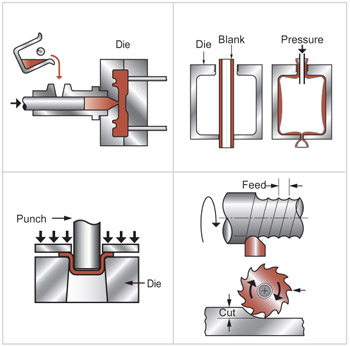
Each process is characterized by a set of attributes: the materials it can handle, the shapes it can make and their precision, complexity, and size. The intimate details of processes make tedious reading, but have to be faced: we describe them briefly in Section 7.3, using process selection charts to capture their attributes.
Process selection finding the best match between process attributes and design requirements is the subject of Sections 7.4 and 7.5. In using the methods developed there, one should not forget that material, shape, and processing interact (Figure 7.1). Material properties and shape limit the choice of process: ductile materials can be forged, rolled, and drawn; those that are brittle must be shaped in other ways. Materials that melt at modest temperatures to low-viscosity liquids can be cast; those that do not have to be...

 TABLE OF CONTENTS