Materials Selection in Mechanical Design, Third Edition

6.5: Cost: Structural Materials for Buildings

6.5 Cost: Structural Materials for Buildings

The most expensive thing that most people buy is the house they live in. Roughly half the cost of a house is the cost of the materials of which it is made, and they are used in large quantities (family house: around 200 tonnes; large apartment block: around 20,000 tonnes). The materials are used in three ways: structurally to hold the building up; as cladding, to keep the weather out; and as "internals", to insulate against heat, sound, and so forth.

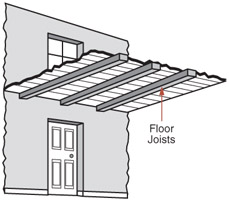
Consider the selection of materials for the structure (Figure 6.7). They must be stiff, strong, and cheap. Stiff, so that the building does not flex too much under wind loads or internal loading. Strong, so that there is no risk of it collapsing. And cheap, because such a lot of material is used. The structural frame of a building is rarely exposed to the environment, and is not, in general, visible, so criteria of corrosion resistance or appearance are not important here. The design goal is simple: strength and stiffness at minimum cost. To be more specific: consider the selection of material for floor beams. Table 6.7 summarizes the requirements.

Table 6.7: Design requirements for floor beams

Function

Floor beam

Constraints

  • Length L specified

  • Stiffness: must not deflect too much under design loads

  • Strength: must not fail under design loads

Objective

  • Minimize the cost, C

Free variables

  • Cross-section area of beam, A

  • Choice of material


Figure 6.7: The materials of a building...

UNLIMITED FREE
ACCESS
TO THE WORLD'S BEST IDEAS

SUBMIT
Already a GlobalSpec user? Log in.

This is embarrasing...

An error occurred while processing the form. Please try again in a few minutes.

Customize Your GlobalSpec Experience

Category: Beams, Joists, and Wall Studs
Finish!
Privacy Policy

This is embarrasing...

An error occurred while processing the form. Please try again in a few minutes.