Materials Selection in Mechanical Design, Third Edition

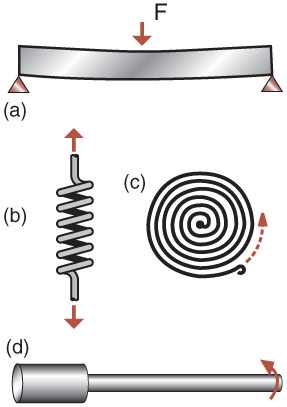
Springs come in many shapes (Figure 6.11 and Table 6.11) and have many purposes: think of axial springs (e.g. a rubber band), leaf springs, helical springs, spiral springs, torsion bars. Regardless of their shape or use, the best material for a spring of minimum volume is that with the greatest value of
/ E, and for minimum weight it is that with the greatest value of
/ ?E (derived below). We use them as a way of introducing two of the most useful of the charts: Young's modulus E plotted against strength ? f, and specific modulus E/ ? plotted against specific strength ? f/ ? (Figures 4.5 and 4.6).
| Function | Elastic spring |
| Constraints | No failure, meaning ? < ? f throughout the spring |
| Objective |
|
| Free variables | Choice of material |
The primary function of a spring is to store elastic energy and when required release it again. The elastic energy stored per unit volume in a block of material stressed uniformly to a stress ? is
| (6.21) | |
where E