Materials Selection in Mechanical Design, Third Edition

Pressure vessels, from the simplest aerosol-can to the biggest boiler, are designed, for safety, to yield or leak before they break. The details of this design method vary. Small pressure vessels are usually designed to allow general yield at a pressure still too low to cause any crack the vessel may contain to propagate ("yield before break"); the distortion caused by yielding is easy to detect and the pressure can be released safely. With large pressure vessels this may not be possible. Instead, safe design is achieved by ensuring that the smallest crack that will propagate unstably has a length greater than the thickness of the vessel wall ("leak before break"); the leak is easily detected, and it releases pressure gradually and thus safely (Table 6.19). The two criteria lead to different material indices. What are they?
| Function | Pressure vessel (contain pressure p safely) |
| Constraints | Radius R specified |
| Objective |
|
| Free variables | Choice of material |
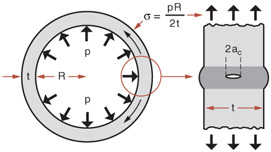
The stress in the wall of a thin-walled spherical pressure vessel of radius R (Figure 6.19) is
| (6.38) | |
In pressure vessel design, the wall thickness, t, is chosen so that, at the working pressure