Materials: Engineering, Science, Processing and Design

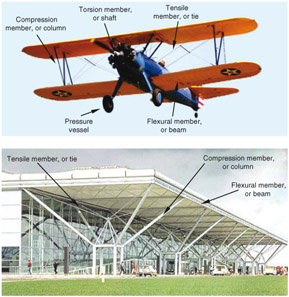
Modes of loading. (Image of Stansted Airport courtesy of Norman Foster and Partners, London, UK)
Stress causes strain. If you are human, the ability to cope with stress without undue strain is called resilience. If you are a material, it is called elastic modulus.
Stress is something that is applied to a material by loading it. Strain a change of shape is its response; it depends on the magnitude of the stress and the way it is applied the mode of loading. The cover picture illustrates the common ones. Ties carry tension often, they are cables. Columns carry compression tubes are more efficient as columns than solid rods because they don't buckle as easily. Beams carry bending moments, like the wing spar of the plane or the horizontal roof beams of the airport. Shafts carry torsion, as in the drive shaft of cars or the propeller shaft of the plane. Pressure vessels contain a pressure, as in the tires of the plane. Often they are shells: curved, thin-walled structures.
Stiffness is the resistance to change of shape that is elastic, meaning that the material returns to its original shape when the stress is removed. Strength (Chapter 6) is its resistance to permanent distortion or total failure. Stress and strain are not material properties; they describe a stimulus and a response. Stiffness (measured by the elastic modulus E, defined in a moment) and strength (measured by the elastic limit ? y or tensile strength ? ts