Materials: Engineering, Science, Processing and Design
Chapter 16: Materials for Optical Devices

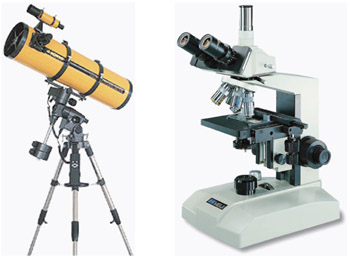
Instruments using the ability of materials to reflect and refract. (Image of microscope courtesy of A Z Microscope Corporation, California USA.)

16.1 Introduction and Synopsis

It was at one time thought that the fact that light could travel through space from the sun to earth, for instance must mean that space was not really empty but filled with 'luminiferous ether'. It was not until the experiments of Michelson [1] and Morley in 1881 that it was realized that light did not need a 'material' for its propagation but could propagate through totally empty space at what is now seen as the ultimate velocity: 3 10 8m/s.

When radiation strikes materials, things can happen. Materials interact with radiation by reflecting it, absorbing it, transmitting it and refracting it. This chapter is about these interactions, the materials that do them best and the ways we use them. The chapter opening page shows two: a reflecting telescope and a refracting microscope, each of which depend on the optical properties of materials.

[1]Albert A. Michelson (1852 1931), Prussian-American experimental physicist, who, with E.W. Morley, first demonstrated that the speed of light is independent of the earth's motion, a finding central to the establishment of the theory of relativity.

16.2 The Interaction of Materials and Radiation

Electromagnetic (e-m) radiation permeates the entire universe. Observe the sky with your eye and you see the visible spectrum, the range of wavelengths we call 'light' (0.40 0.77 ?m). Observe it with a detector of X-rays or ?-rays...

UNLIMITED FREE
ACCESS
TO THE WORLD'S BEST IDEAS

SUBMIT
Already a GlobalSpec user? Log in.

This is embarrasing...

An error occurred while processing the form. Please try again in a few minutes.

Customize Your GlobalSpec Experience

Category: Circular Polarizers
Finish!
Privacy Policy

This is embarrasing...

An error occurred while processing the form. Please try again in a few minutes.