Materials: Engineering, Science, Processing and Design

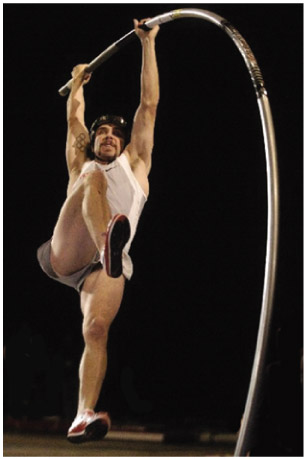
A pole vaulter the pole stores elastic energy. (Image courtesy of Gill Athletics, 2808 Gemini Court, Champaign, IL 61822-9648, USA)
A few years back, with the millennium approaching, countries and cites around the world turned their minds to iconic building projects. In Britain there were several. One was well, is a new pedestrian bridge spanning the river Thames, linking St Paul's Cathedral to the Museum of Modern Art facing it across the river. The design was oops, is daring: a suspension bridge with suspension cables that barely rise above the level of the deck instead of the usual great upward sweep. The result was visually striking: a sleek, slender, span like a 'shaft of light' (the architect's words). Just one problem: it wasn't stiff enough. The bridge opened but when people walked on it, it swayed and wobbled so alarmingly that it was promptly closed. A year and $5 000 000 later it reopened, much modified, and now it is fine.
The first thing you tend to think of with structures, bridges included, is strength: they must not fall down. Stiffness, often, is taken for granted. But, as the bridge story relates, that can be a mistake stiffness is important. Here we explore stiffness-limited design and the choice of materials to achieve it. This involves the modeling of material response in a given application. The models can be simple because the selection criteria that emerge are insensitive to the details of shape and loading. The key steps...